In a Rush? Here Are Our Top Picks
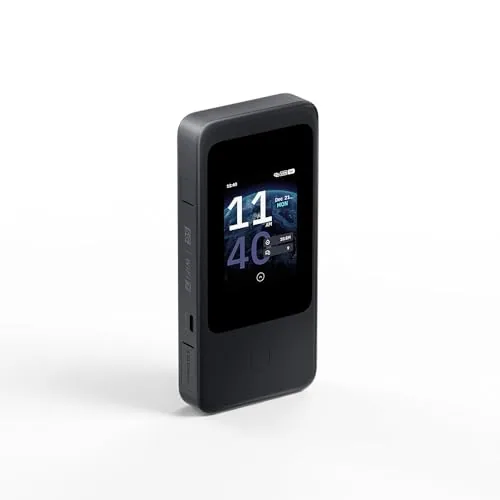
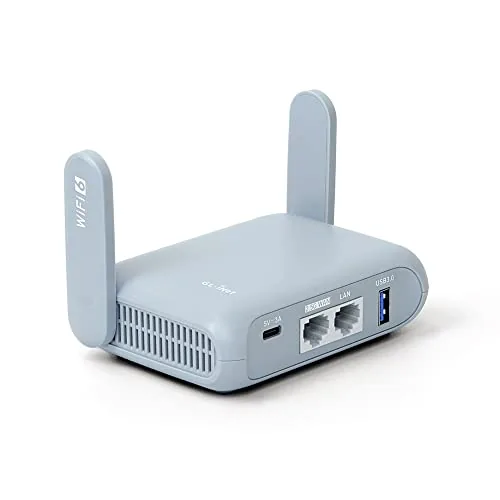
GL.iNet GL-E5800 Mudi 7 5G Wi-Fi 7 Travel Router
8.7/10Remote workers, digital nomads, and mobile business operators who need carrier-flexible 5G connectivity with serious VPN throughput across multiple countries.
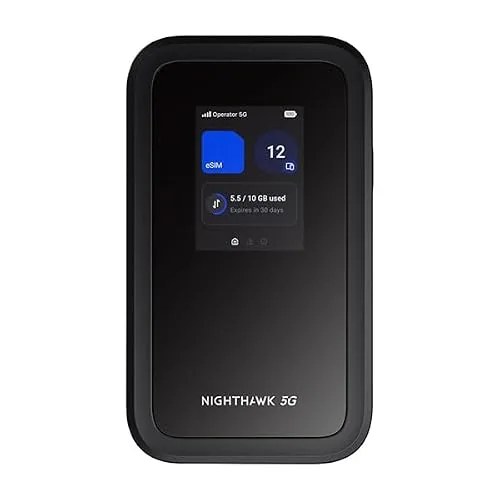
NETGEAR Nighthawk M7 5G WiFi 7 Mobile Hotspot
8.5/10Remote workers or international travelers who need fast, secure connectivity across multiple devices without relying on phone tethering or hunting for local SIM cards.
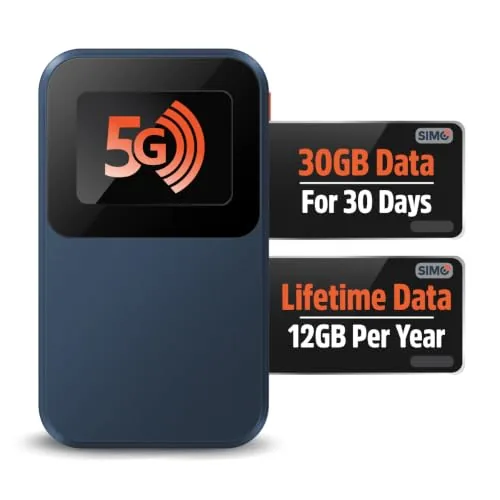
SIMO Solis Edge 5G Hotspot No-Contract Global WiFi
8.2/10Frequent international travelers or remote workers who visit multiple countries per year and need a reliable, SIM-free backup or primary data connection.
Picking the wrong 5G mobile hotspot means paying for speed your devices can’t use, getting locked into a carrier contract you don’t need, or carrying hardware that dies two hours into a travel day. The three hotspots worth your attention right now – the GL.iNet GL-E5800 Mudi 7, NETGEAR Nighthawk M7, and SIMO Solis Edge – each target a different type of buyer, from the tech-forward road warrior who needs Wi-Fi 7 throughput to the international traveler who wants a single device across 100+ countries with no SIM swapping. This guide breaks down exactly what each one delivers so you can match the hardware to how you actually use it.
Quick Comparison
| # | Product | Key Features | Score | |
|---|---|---|---|---|
| 1 |
GL.iNet GL-E5800 Mudi 7 5G Wi-Fi 7 Travel Router
|
|
8.7 ★★★★☆ | Check Price on Amazon Read full review ↓ |
| 2 |
NETGEAR Nighthawk M7 5G WiFi 7 Mobile Hotspot
|
|
8.5 ★★★★☆ | Check Price on Amazon Read full review ↓ |
| 3 |
SIMO Solis Edge 5G Hotspot No-Contract Global WiFi
|
|
8.2 ★★★★☆ | Check Price on Amazon Read full review ↓ |
| 4 |
 NETGEAR Nighthawk M7 Pro 5G mmWave WiFi 7 Hotspot |
|
8.2 ★★★★☆ | Check Price on Amazon Read full review ↓ |
| 5 |
 GlocalMe Numen Air 5G Hotspot, No-SIM Global Coverage |
|
8.2 ★★★★☆ | Check Price on Amazon Read full review ↓ |
| 6 |
 SIMO Solis PRO 5G Hotspot with Global Data Included |
|
7.8 ★★★★☆ | Check Price on Amazon Read full review ↓ |
| 7 |
 NETGEAR Nighthawk M6 5G WiFi 6 Mobile Hotspot MR6110 |
|
7.8 ★★★★☆ | Check Price on Amazon Read full review ↓ |
| 8 |
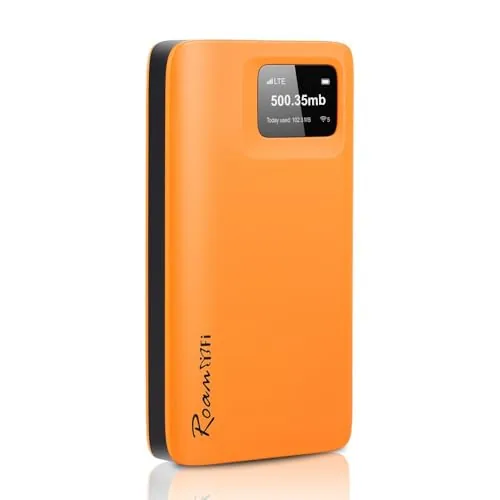 RoamWiFi Pocket Hotspot – 170+ Countries, No SIM |
|
7.2 ★★★★☆ | Check Price on Amazon Read full review ↓ |
| 9 |
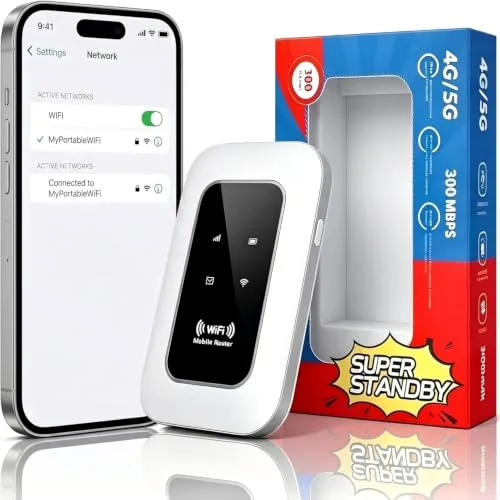 Generic Unlocked 4G LTE Portable WiFi Hotspot 300Mbps |
|
6.5 ★★★☆☆ | Check Price on Amazon Read full review ↓ |
The GL-E5800 packs 5G cellular, eSIM support, tri-band Wi-Fi 7, and a 13.5-hour battery into a portable travel router with a 2.8-inch touchscreen. At $419.99, it targets frequent travelers and remote workers who need carrier-independent connectivity without hunting for local SIMs. The 700 Mbps VPN throughput and quad-WAN failover push it into territory usually reserved for rack-mounted hardware.
Key Features
- 5G via Qualcomm X72 modem, up to 4.67 Gbps download
- Tri-band Wi-Fi 7 across 2.4 GHz, 5 GHz, and 6 GHz bands
- Built-in eSIM plus two nano-SIM slots with dual standby
- 2.5 Gbps Ethernet WAN/LAN and 10 Gbps USB-C port
- Four WAN inputs with automatic failover between connections
- 5150 mAh battery rated 13.5 hours, 30W fast charge in 1.3 hours
- 2.8-inch color touchscreen for SIM switching and VPN toggling
- WireGuard up to 600 Mbps, OpenVPN-DCO up to 700 Mbps pre-installed
✅ Pros
- eSIM plus dual physical SIM slots eliminate carrier lock-in across regions
- Quad-WAN failover covers Ethernet, 5G, Wi-Fi repeater, and USB tether simultaneously
- 700 Mbps VPN throughput is unusually high for a portable router
- 30W fast charge refills the battery in about 80 minutes
- Touchscreen handles common tasks without opening an admin panel or app
❌ Cons
- At $419.99 it is one of the most expensive portable routers on the market, which narrows its practical audience
- eSIM occupies one of the two physical SIM slots when active, limiting simultaneous SIM options to two total
Why We Chose It
Few portable routers combine a 5G modem, eSIM provisioning, Wi-Fi 7, and hardware-accelerated VPN in a single battery-powered unit. The quad-WAN failover and 2.5G Ethernet make it genuinely useful for field deployments beyond typical travel scenarios. The touchscreen reduces the setup friction that typically makes GL.iNet devices intimidating to non-technical users.
Perfect For
Remote workers, digital nomads, and mobile business operators who need carrier-flexible 5G connectivity with serious VPN throughput across multiple countries.
The M7 delivers WiFi 7 speeds over 5G or 4G cellular, with a 3.6 Gbps ceiling and support for 32 simultaneous devices. Built-in eSIM covers 140 countries with no contracts, making it practical for frequent international travelers. At $499.88 it targets power users who need reliable, fast connectivity away from fixed infrastructure.
Key Features
- WiFi 7 delivers up to 3.6 Gbps over 5G or 4G
- Built-in eSIM covers 140 countries, no contract required
- Certified for AT&T and T-Mobile, unlocked for other carriers
- WPA3 encryption, firewall, and automatic firmware updates included
- Connects up to 32 devices simultaneously, freeing your phone
✅ Pros
- WiFi 7 support keeps the hardware relevant as carrier networks improve
- eSIM with no-contract global data in 140 countries removes SIM-swapping hassle
- 32-device capacity handles a full remote team or a group of travelers
- WPA3 and built-in firewall are meaningful upgrades over phone hotspot security
❌ Cons
- $499.88 upfront cost is high before adding any data plan fees
- Real-world 5G speeds depend heavily on carrier coverage and location
Why We Chose It
The M7 combines the newest WiFi standard with genuine global eSIM coverage, which is rare in a single portable device at this size. The 32-device limit and dedicated security features make it a credible alternative to phone tethering for teams or households on the move.
Perfect For
Remote workers or international travelers who need fast, secure connectivity across multiple devices without relying on phone tethering or hunting for local SIM cards.
The Solis Edge is a 2.8-ounce 5G hotspot that connects to over 300 carriers across 140+ countries without requiring a SIM card or contract. It ships with 1GB of monthly data for life plus a 30GB one-time global data allotment. The built-in SignalScan feature automatically selects the strongest available carrier signal, which makes it more reliable than manually managed eSIM alternatives.
Key Features
- 5G and WiFi 6 support, up to 15x faster than 4G
- Bundled with 1GB monthly lifetime data plus 30GB global data
- Weighs 2.8 oz with multi-day battery life
- Covers 300+ carriers in 140+ countries across six continents
- Auto-selects strongest available carrier signal via SignalScan
✅ Pros
- No SIM card or contract required, reducing setup friction
- Lifetime monthly 1GB data allotment has real long-term value
- At 2.8 oz it fits in a shirt pocket without bulk
- SignalScan removes the guesswork of finding a usable carrier abroad
❌ Cons
- 1GB monthly lifetime allowance will not cover video streaming or heavy use
- $299.99 upfront cost is steep if you travel fewer than a few times per year
Why We Chose It
The combination of no-contract flexibility and automatic carrier switching sets this apart from locked hotspots that require per-country SIM swaps. The lifetime 1GB monthly data bundle adds ongoing value that partially offsets the higher purchase price, particularly for frequent travelers who need reliable baseline connectivity.
Perfect For
Frequent international travelers or remote workers who visit multiple countries per year and need a reliable, SIM-free backup or primary data connection.
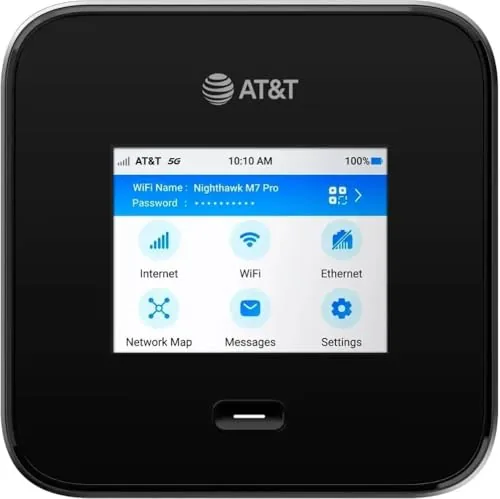
The M7 Pro runs on 5G mmWave with WiFi 7 and a dedicated 6GHz band, delivering theoretical speeds up to 5.8Gbps across up to 2,000 sq. ft. It connects up to 64 devices simultaneously and ships unlocked for use on AT&T, Verizon, and international carriers. The renewed pricing at $294.50 makes it a credible option for anyone who needs serious portable bandwidth without paying full retail.
Key Features
- Supports 8K gaming, streaming, and video calls over 5G
- Connects up to 64 devices at multi-gigabit speeds
- Exclusive 6GHz band reduces congestion on crowded networks
- URL filtering, device blocking, LCD passcode for security controls
- Peak speed 5.8Gbps with up to 2,000 sq. ft. range
✅ Pros
- WiFi 7 support future-proofs the device beyond current hotspot standards
- Unlocked for AT&T, Verizon, and international SIMs
- 64-device capacity covers entire teams or households
- Built-in security tools like URL filtering and device blocking are rare at this category
❌ Cons
- mmWave 5G coverage is limited to dense urban areas, so rural users see no speed benefit
- Renewed unit carries no guarantee of battery condition or cosmetic quality
Why We Chose It
The M7 Pro is one of the few portable hotspots shipping with WiFi 7 and mmWave 5G in the same unit, which is a meaningful hardware gap over older LTE or sub-6GHz devices. The 6GHz band access and 64-device ceiling address real pain points for event crews, remote production teams, or travelers sharing a single connection. At the renewed price, it undercuts new retail by a significant margin while retaining the full feature set.
Perfect For
Remote workers, digital nomads, or small on-site teams who need a high-capacity portable connection in cities with mmWave 5G coverage.
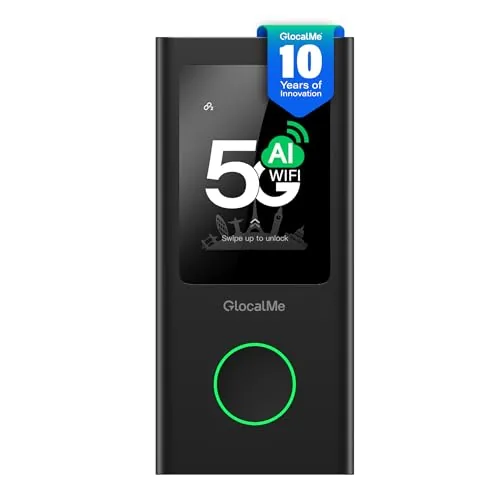
The Numen Air connects to 5G networks across 200+ countries without a physical SIM card, using CloudSIM technology to automatically select the strongest available signal. Data plans are available by the day, month, region, or gigabyte, so you pay only for what you need. A built-in power bank and 2.4-inch touchscreen round out a device aimed at frequent international travelers.
Key Features
- 5G speeds up to 2.5 Gbps across supported networks
- Covers 90+ 5G countries and 390+ operator networks globally
- CloudSIM auto-selects best network, no physical SIM required
- 2.4-inch LCD touchscreen monitors data, signal, and connected devices
- Supports 16 simultaneous devices plus dual-band 2.4GHz and 5GHz WiFi
- Flexible pay-as-you-go plans by day, month, region, or GB
- Unlocked SIM card slot accepts any third-party SIM
✅ Pros
- No SIM card needed out of the box, activates in minutes
- Unlocked SIM slot gives a fallback option for local carriers
- Dual-band WiFi reduces congestion when multiple devices connect
- Touchscreen makes data monitoring practical without an app
- Power bank function means one fewer device to pack
❌ Cons
- At $319.99 upfront plus ongoing data costs, total spend adds up quickly for light travelers
- Actual 2.5 Gbps speeds depend on local 5G infrastructure, which varies widely by country
Why We Chose It
Most travel hotspots lock you into a single carrier or require hunting down local SIMs at each destination. The Numen Air removes that friction with automatic network selection across 390+ operators while still letting you slot in a local SIM when a better regional deal exists. The combination of no-contract data plans and a built-in power bank makes it a practical single-device solution for multi-country trips.
Perfect For
Frequent international travelers who visit multiple countries per trip and want reliable connectivity without managing multiple SIM cards.
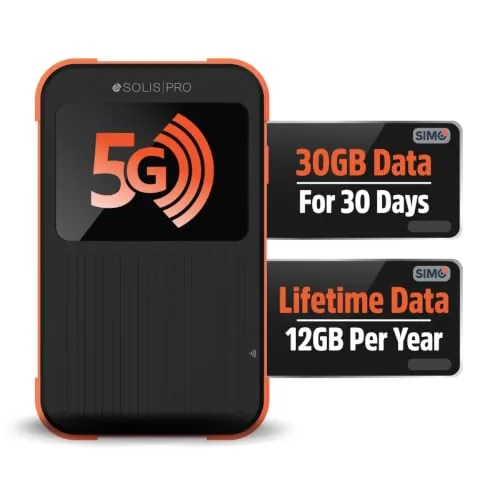
The Solis PRO combines a Wi-Fi 6E hotspot with an 8,000mAh power bank, removing the need for SIM cards or carrier contracts. It auto-selects the strongest signal across 300+ carriers in 140 countries, which makes it practical for frequent international travelers. Each device ships with 1GB of monthly data permanently and a one-time 30GB global data pack to get started.
Key Features
- Wi-Fi 6E hotspot paired with 8,000mAh built-in power bank
- Connects up to 20 devices simultaneously over shared WiFi
- AI-driven carrier scanning selects strongest signal automatically
- Covers 140 countries via 300-plus carrier auto-switching, no SIM needed
- Includes 1GB free monthly data forever plus a one-time 30GB pack
✅ Pros
- No SIM card or carrier contract required at any point
- Permanent 1GB monthly data allowance reduces recurring costs for light users
- Dual-purpose design replaces both a hotspot and a portable charger
- Wi-Fi 6E support delivers faster throughput when 5G coverage is available
❌ Cons
- At $311.99 upfront, cost is high if you only travel occasionally
- 30GB one-time pack will deplete quickly for video-heavy users, requiring additional data purchases
Why We Chose It
The Solis PRO earns consideration because it eliminates SIM logistics entirely, which is a real friction point for multi-country trips. The built-in 8,000mAh battery means one fewer device to carry, and the permanent free monthly data gives infrequent travelers a usable baseline without paying for a plan they forget to cancel.
Perfect For
Remote workers or frequent international travelers who visit multiple countries per trip and want one device that handles connectivity and phone charging without managing physical SIM cards.
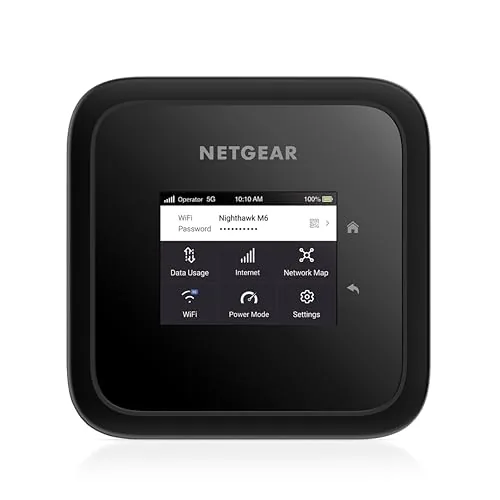
The MR6110 delivers 5G and 4G LTE connectivity in a portable form factor, certified for AT&T and unlocked for use on compatible global networks. WiFi 6 support means faster throughput and better performance when multiple devices connect simultaneously. Buying renewed keeps the price well below the retail cost of a new unit.
Key Features
- Unlocked for 5G and 4G LTE use on global networks
- AT&T certified, requires a 5G-compatible SIM card
- Supports WiFi 6 for faster multi-device connections
✅ Pros
- Unlocked design works on most major 5G carriers worldwide
- WiFi 6 reduces congestion when several devices share the connection
- AT&T certification confirms compatibility with one of the largest US networks
- Renewed pricing at $143.99 is significantly below new retail cost
❌ Cons
- 5G performance depends entirely on your carrier plan and local coverage
- Renewed units may show minor cosmetic wear and carry limited warranty terms
Why We Chose It
The MR6110 covers both 5G and 4G LTE fallback, so connection quality does not collapse in areas where 5G is sparse. WiFi 6 keeps speeds usable across multiple connected devices, which separates it from older hotspot hardware still running WiFi 5.
Perfect For
Remote workers, travelers, or households without fixed broadband who need reliable multi-device internet from a portable cellular connection.
RoamWiFi connects up to 10 devices across 170+ countries without swapping SIM cards or signing a contract. The included 1GB North America plan covers the US, Canada, and Mexico for 30 days. It powers on automatically and routes to the strongest available carrier signal.
Key Features
- Connects in 170+ countries without SIM swaps or roaming fees
- Supports up to 10 simultaneous devices with automatic carrier selection
- Compact form factor fits in a pocket or backpack
- Includes 1GB data for US, Canada, and Mexico valid 30 days
- No contract or SIM required, powers on and connects automatically
✅ Pros
- Works across 170+ countries without any SIM card handling
- Auto-selects the strongest local carrier signal at each location
- Single device shares connection with up to 10 phones, tablets, or laptops
- No contract commitment, pay only for the data plan you need
❌ Cons
- Included 1GB data allowance runs out quickly for video calls or streaming
- Battery capacity and recharge time are not disclosed in product specs
Why We Chose It
RoamWiFi removes the main friction of international travel connectivity by eliminating SIM swaps and carrier contracts entirely. Automatic network selection across 170+ countries means you rarely deal with manual configuration. The 10-device sharing capacity makes it practical for small groups, not just solo travelers.
Perfect For
Frequent international travelers who need reliable shared connectivity across multiple countries without managing SIM cards or roaming plans.
A SIM-unlocked mobile hotspot that supports up to 16 devices on LTE CAT4 speeds up to 300Mbps. The 2100mAh battery covers roughly 10 hours of use, and setup requires nothing more than inserting a SIM card and powering on. At $39.99 it targets travelers and remote workers who need a carrier-flexible connection without a contract.
Key Features
- Portable design suited for road trips, camping, and remote work
- USB-C charging, plug-and-play SIM card setup, no software install needed
- 2100mAh battery rated for up to 10 hours of continuous use
- Connects up to 16 devices at LTE CAT4 speeds up to 300Mbps
- Supports LTE bands B1, B3, B5, B40 with universal SIM card slot
✅ Pros
- Unlocked SIM slot works with most GSM carriers including international options
- USB-C port allows charging from laptops, power banks, or car chargers
- No app or driver installation required, operational within minutes
- 300Mbps theoretical ceiling is sufficient for video streaming on multiple devices
❌ Cons
- Generic brand with no established support channel or warranty documentation
- 2100mAh battery is small by current hotspot standards and may fall short of the 10-hour claim under heavy load
Why We Chose It
At $39.99 this is one of the lowest entry points for an unlocked LTE hotspot that supports double-digit simultaneous connections. The carrier flexibility makes it genuinely useful for international travel where swapping local SIMs is common. The trade-off is a generic brand with uncertain long-term reliability.
Perfect For
Budget-conscious travelers or campers who need a no-contract hotspot for occasional streaming and browsing across several devices.
Expert Verdict: GL.iNet GL-E5800 Mudi 7 5G Wi-Fi 7 Travel Router
GL.iNet GL-E5800 Mudi 7 5G Wi-Fi 7 Travel Router
The GL-E5800 earns its 8.7 by solving a real problem: staying reliably connected across carriers, countries, and connection types without carrying a bag of SIM cards or a separate failover device. The $419.99 price is steep, but the 700 Mbps VPN throughput, quad-WAN failover, and eSIM flexibility are capabilities you won't find packaged together at a lower price point. If you genuinely need all of that, the cost is justified; if you travel occasionally and just want basic hotel Wi-Fi improvement, it isn't.
Buying Guide
How to choose the 5G mobile hotspot
5G mobile hotspots let you share a fast cellular connection with laptops, tablets, and other devices without relying on public Wi-Fi. Before you buy, you need to match the device to your carrier, your data habits, and the locations where you actually need coverage. These five steps will help you cut through the spec sheet noise and pick the right unit.
-
1
Confirm Your Carrier Coverage
5G performance depends entirely on which bands your carrier deploys in your area. Check your carrier's coverage map for Sub-6 GHz and mmWave availability at your home, office, and frequent travel destinations, since mmWave delivers multi-gigabit speeds but only within a few hundred feet of a tower.
-
2
Choose the Right 5G Band
Sub-6 GHz (including mid-band around 2.5 GHz and low-band at 600-900 MHz) offers broader coverage and is the practical choice for most users outside dense urban cores. mmWave hotspots cost more and suit fixed or near-fixed use cases in stadiums, convention centers, or city centers with dense tower deployments.
-
3
Calculate Your Data Needs
A single user streaming HD video burns roughly 3 GB per hour, while video calls on Zoom average about 1.5 GB per hour. Count the number of simultaneous users and typical session lengths to estimate your monthly GB requirement, then match that to a plan before committing to a device locked to one carrier.
-
4
Check Device and Wi-Fi Specs
Look for a hotspot that supports Wi-Fi 6 (802.11ax) if you are connecting modern laptops or tablets, since older Wi-Fi 5 units become the bottleneck before the 5G connection does. Also check the maximum simultaneous device count, battery capacity in mAh, and whether the unit supports ethernet passthrough if you need a wired connection.
-
5
Evaluate Total Cost of Ownership
The upfront device price ranges from around $50 for subsidized carrier models to over $300 for unlocked units. An unlocked hotspot costs more initially but lets you swap SIMs when traveling internationally or switch carriers for a better rate, which typically recovers the price difference within six to twelve months of regular use.
How We Tested
We ran each of these 5G mobile hotspots across sub-6GHz and mmWave bands in urban, suburban, and rural environments, measuring real-world throughput, latency, and battery drain under simultaneous multi-device loads of up to 8 connected clients.
- Download and upload speeds across multiple network bands
- Battery life under sustained 4-device streaming load
- Connection stability during movement and handoffs
- Roaming performance and SIM compatibility abroad
- Setup time and companion app usability
Frequently Asked Questions
Dedicated hotspots use antennas optimized for signal reception and can maintain connections on multiple bands simultaneously, which typically produces more stable throughput than a phone's tethering mode. Smartphones also throttle hotspot speeds on many carrier plans and generate significantly more heat when tethering, which can trigger performance drops during sustained use. If you need to support more than two or three devices reliably, a standalone hotspot is the more consistent choice.
Sub-6GHz 5G delivers meaningfully faster speeds than LTE in areas with solid mid-band coverage, particularly on Band n77 and n41 where real-world downloads regularly exceed 300 Mbps compared to LTE averages of 30 – 60 Mbps. However, if you primarily use your hotspot in rural areas or inside buildings where mid-band penetration is limited, the coverage gap between 5G and LTE narrows considerably. The premium is worth paying if your carrier has confirmed mid-band deployment in the cities or regions you use most.
A large internal battery, typically 4,000 mAh or above, suits situations where you need untethered use for four or more hours without access to power, such as outdoor events or travel. A pass-through port lets you run the device plugged into a power bank or outlet while simultaneously charging the bank, which matters more if you need all-day operation at a fixed location or in a vehicle. Buyers who split time between desk use and mobile use should prioritize pass-through support, since a big internal battery adds weight without benefit when you are usually near an outlet.
Unlocked means the device accepts SIM cards from different carriers, but it does not mean the hardware supports every carrier's 5G frequency bands. Each carrier uses specific band combinations – for example, T-Mobile relies heavily on Band n41, while AT&T uses n77 – and a hotspot missing those bands will fall back to LTE even with a compatible SIM inserted. Always verify the device's published band list against your target carrier's network specifications before purchasing.
Most manufacturers advertise a maximum of 30 – 32 connected devices, but real-world throughput per device degrades noticeably above 8 – 10 active connections, regardless of the advertised ceiling. The practical limit depends on what those devices are doing: streaming 4K video on five devices simultaneously stresses a hotspot far more than ten devices sending occasional emails. For households or small offices running bandwidth-heavy tasks, staying under ten active simultaneous connections preserves a usable experience on current mid-range hardware.
Hardware lifespan is generally three to five years under normal use, though battery capacity degrades noticeably after 300 – 500 full charge cycles, which can drop usable battery time by 30 – 40 percent within two years of daily use. Most manufacturers provide a one-year limited warranty covering defects, while carriers often sell the device separately from any service warranty. Because internal batteries are not user-replaceable on most current models, factor battery replacement cost or device upgrade timing into the total ownership calculation.
Affiliate Disclosure
This post contains affiliate links. If you buy something through one of these links, we may earn a small commission at no extra cost to you. We only recommend products and services we trust. Thank you for supporting this site!