In a Rush? Here Are Our Top Picks
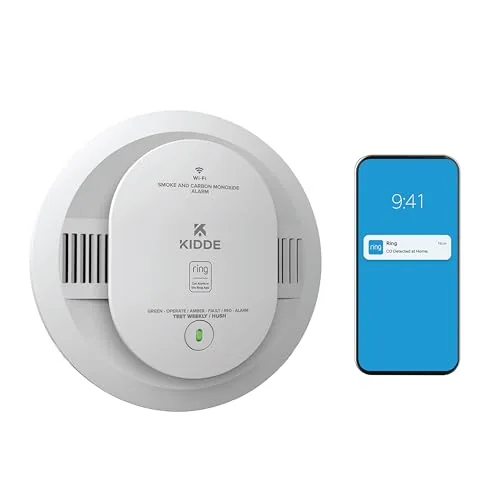
Kidde Smart Smoke & CO Detector, Ring-Connected, Battery
8.2/10Renters or homeowners in older buildings who want app-connected smoke and CO detection without running new wiring.
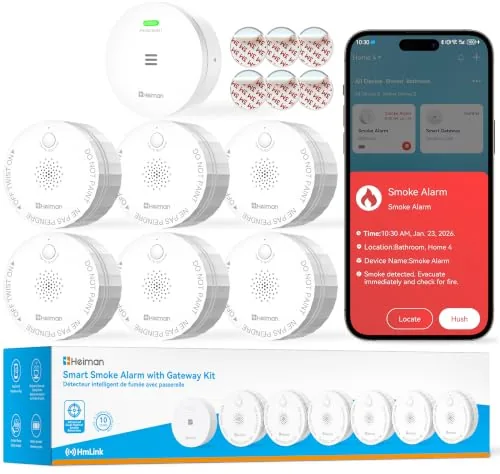
HEIMAN S1-R 6-Pack Wireless Interconnected Smart Smoke Detector
8.2/10Landlords, property managers, or homeowners who need a code-compliant, battery-powered interconnected smoke alarm system across multiple rooms or floors without running new wiring.
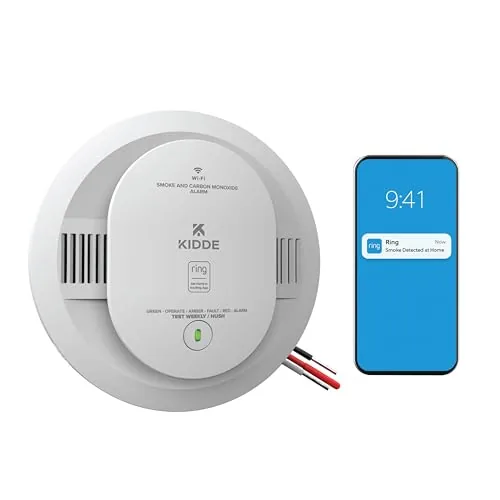
Kidde RGCUAR-RW Smart Smoke & CO Detector with Ring
8.2/10Homeowners or renters with existing hardwired smoke alarms who want real-time phone notifications and are already using Ring or Alexa devices.
Smart smoke detectors do more than trigger an alarm – they send alerts to your phone, integrate with home automation systems, and in many cases, tell you exactly which room has a problem before you even smell smoke. The models worth buying in 2024 fall into a few clear categories: battery-powered standalone units like the Ring-Connected, interconnected mesh systems like the HEIMAN S1-R 6-Pack, and combination smoke and CO detectors like the Kidde Smart Smoke & CO and its Ring-integrated sibling, the Kidde RGCUAR-RW. This guide breaks down who each one is built for, where each falls short, and which is worth the price.
Quick Comparison
| # | Product | Key Features | Score | |
|---|---|---|---|---|
| 1 |
Kidde Smart Smoke & CO Detector, Ring-Connected, Battery
|
|
8.2 ★★★★☆ | Check Price on Amazon Read full review ↓ |
| 2 |
HEIMAN S1-R 6-Pack Wireless Interconnected Smart Smoke Detector
|
|
8.2 ★★★★☆ | Check Price on Amazon Read full review ↓ |
| 3 |
Kidde RGCUAR-RW Smart Smoke & CO Detector with Ring
|
|
8.2 ★★★★☆ | Check Price on Amazon Read full review ↓ |
| 4 |
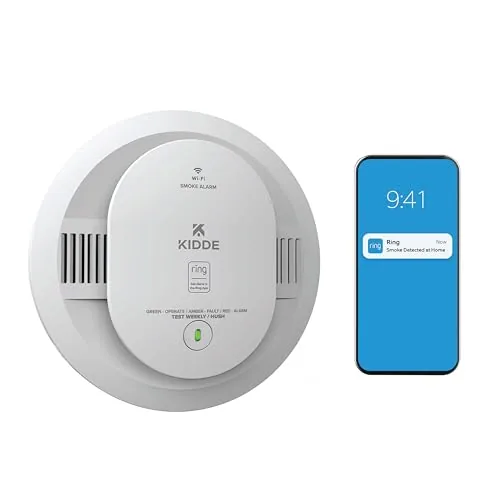 Kidde RGSDR-RW Smart Smoke & CO Detector, AA Battery |
|
8.2 ★★★★☆ | Check Price on Amazon Read full review ↓ |
| 5 |
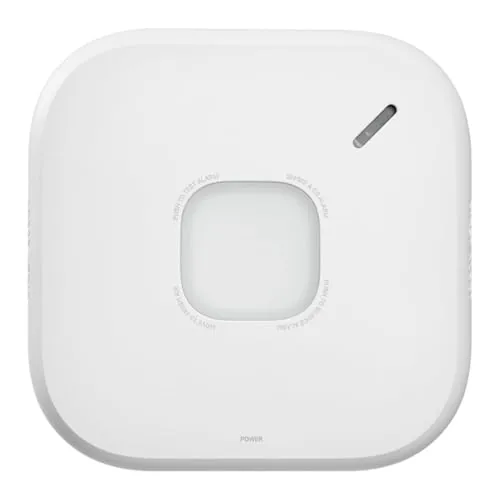 First Alert SMCO600NV Smart Smoke & CO Alarm |
|
8.2 ★★★★☆ | Check Price on Amazon Read full review ↓ |
| 6 |
 X-Sense XP0H-WN Wireless Interconnected Smoke & CO Detector 3-Pack |
|
8.2 ★★★★☆ | Check Price on Amazon Read full review ↓ |
| 7 |
 Kidde RGSAR-RW Smart Smoke Detector with Ring Integration |
|
8.2 ★★★★☆ | Check Price on Amazon Read full review ↓ |
This battery-powered combo detector links to the Ring app for real-time smoke, CO, and low-battery alerts without a subscription. Wireless interconnect means all paired Kidde alarms sound simultaneously when one triggers. improved sensing is tuned to reduce kitchen false alarms compared to previous Kidde generations.
Key Features
- Detects both smoke and carbon monoxide in one unit
- Sends smoke, CO, and low battery alerts via Ring app, no subscription required
- Internal testing shows over 25% faster smoke detection than a leading competitor
- Optional 24/7 professional monitoring available for $5 per month
- Runs on 2 AA alkaline batteries, no wiring required
- Wirelessly interconnects with other Kidde alarms so all units sound together
- Reduced false alarms from cooking versus prior Kidde generations
- Sends low-level CO mobile alerts before CO reaches dangerous concentrations
✅ Pros
- No electrician needed, 2 AA batteries included and installation is DIY
- Ring app alerts work from anywhere with no mandatory subscription fee
- Wireless interconnect covers the whole home without running new wiring
- Low-level CO alerts give earlier warning than detectors that only trigger at high thresholds
❌ Cons
- Full 24/7 professional monitoring requires an ongoing $5 per month Ring subscription
- Battery-only power means regular battery checks are necessary to maintain reliability
Why We Chose It
The combination of app-connected alerts and wire-free whole-home interconnect makes this detector genuinely useful in older homes or apartments where hardwired options are impractical. The no-subscription app alerts lower the barrier to smart home safety compared to competitors that require paid tiers for basic notifications.
Perfect For
Renters or homeowners in older buildings who want app-connected smoke and CO detection without running new wiring.
Six photoelectric smoke alarms pair with a single gateway to deliver both local wireless interconnection and remote smartphone alerts. Each unit runs on a 10-year CR123A battery, eliminating hardwiring and annual replacements. UL 217 10th Edition certification makes this kit viable for landlords and contractors who need to meet current housing codes.
Key Features
- 6 alarms plus gateway, UL 217 10th Edition certified kit
- Wireless interconnect triggers all units when one detects smoke
- Gateway sends instant smartphone or email alerts via 2.4GHz Wi-Fi
- 10-year CR123A lithium battery eliminates hardwiring and annual changes
- Dual-beam photoelectric sensor reduces false alarms from cooking vapors
- Compact 70mm x 37mm body with 85dB siren and LED flash
- Tool-free magnetic mount included, 10-year replacement warranty
- Compatible with Home Assistant, Google Home, SmartThings, and IFTTT
✅ Pros
- UL 217 10th Edition certification satisfies current code requirements for rentals and new builds
- Wireless interconnect works without Wi-Fi, so the system functions during internet outages
- Gateway expands to 24 linked alarms and supports CO, water leak, and door sensors on the same app
- 10-year battery and magnetic mount cut ongoing maintenance time and cost across all six units
❌ Cons
- Gateway requires 2.4GHz Wi-Fi only, which can complicate setup on dual-band routers that share an SSID
- Smart home platform integrations require a compatible hub or ecosystem already in place, adding potential extra cost
Why We Chose It
The combination of UL 217 10th Edition certification, true wireless interconnection without Wi-Fi dependency, and a bundled gateway at $176 for six units makes this competitive against systems that charge separately for the hub. The expandability to 24 sensors across multiple detector types on one app gives landlords and multi-story homeowners room to grow without switching platforms.
Perfect For
Landlords, property managers, or homeowners who need a code-compliant, battery-powered interconnected smoke alarm system across multiple rooms or floors without running new wiring.
This hardwired detector covers both smoke and carbon monoxide, pushing real-time alerts to the Ring app without requiring a subscription. One unit connects to every hardwired alarm in the home, so you get whole-home mobile notifications from a single smart device. At $74.97 it sits at a premium price point, but the app integration and faster detection claim make it a practical upgrade over basic alarms.
Key Features
- Detects both smoke and carbon monoxide in one unit
- Sends smoke, CO, and low battery alerts via Ring app
- Claims over 25 percent faster smoke detection than a leading competitor
- Optional 24/7 professional monitoring available for 5 dollars per month
- One smart detector activates mobile alerts for all hardwired alarms in the home
- Reduced false alarms from cooking compared to prior Kidde generations
- Sends notifications through Alexa-enabled devices
- Certified to UL 217 and FCC standards
✅ Pros
- App alerts work without any paid subscription
- Single unit bridges all existing hardwired alarms to your phone
- Dual smoke and CO detection reduces the number of devices needed
- Alexa integration adds a hands-free notification option
❌ Cons
- Full 24/7 professional monitoring adds an ongoing 5 dollar monthly cost
- Ring ecosystem dependency means limited utility if you use a different smart home platform
Why We Chose It
The whole-home connectivity feature stands out because you only need to buy one of these units to get mobile alerts from every hardwired detector already in your home. The no-subscription app alerts are a genuine value given that competitors often gate basic notifications behind a monthly fee. UL 217 certification and the faster detection claim give it credibility beyond typical smart home gimmicks.
Perfect For
Homeowners or renters with existing hardwired smoke alarms who want real-time phone notifications and are already using Ring or Alexa devices.
This battery-powered detector sends real-time smoke and CO alerts to your phone via the Ring app, with no subscription required for basic notifications. Wireless interconnect means all paired Kidde alarms trigger simultaneously when one detects smoke. improved sensing is designed to cut down on false alarms from everyday cooking.
Key Features
- Ring app sends smoke and low battery alerts, no subscription needed
- Detects smoke over 25% faster than a leading competitor per internal testing
- Optional 24/7 professional monitoring available for $5 per month
- Runs on 2 AA alkaline batteries included, no wiring required
- Wireless interconnect triggers all linked Kidde alarms simultaneously
- Reduced false alarms from cooking versus prior Kidde generations
- Compatible with Alexa for voice notifications on enabled devices
- Certified to UL 217 and FCC standards
✅ Pros
- No subscription needed for app alerts, keeping ongoing costs at zero
- Wire-free setup works in any room without an electrician
- Covers both smoke and carbon monoxide in a single unit
- Whole-home wireless interconnect without dedicated hub hardware
❌ Cons
- 25% faster detection claim is based on Kidde internal testing, not independent verification
- Full 24/7 monitoring requires an ongoing Ring subscription at $5 per month
Why We Chose It
At $49.98 it combines smoke and CO detection with genuine smartphone alerts and no mandatory subscription, which is rare at this price point. The wire-free interconnect across multiple units makes it practical for renters or anyone who cannot hardwire detectors.
Perfect For
Renters or homeowners who want smartphone smoke alerts and whole-home interconnectivity without hardwiring or monthly fees.
This alarm sends phone notifications via the First Alert app when smoke or carbon monoxide is detected, so you get alerts even when you’re away from home. Voice alerts announce the specific type of hazard and which room it’s in, cutting response time in an emergency. At $124.97 it sits at the premium end, but the combination of smart connectivity and interconnect capability covers most households in one package.
Key Features
- Works with Google Nest Protect for expanded smart home integration
- App sends phone alerts when smoke or CO is detected remotely
- Interconnects with compatible alarms so all units sound together
- Low battery alerts sent to your phone to prevent late night chirps
- Voice announcements identify hazard type and specific room location
- Precision Detection Technology reduces false alarms and flags early threats
- Manufacture date printed on unit indicates production date not expiry
✅ Pros
- Remote phone alerts mean you get notified even when away from home
- Room-specific voice warnings reduce confusion during an actual emergency
- Interconnect feature ensures whole-home coverage when any unit triggers
- App-based low battery warnings eliminate disruptive overnight chirping
❌ Cons
- At $124.97 per unit, whole-home coverage requires significant upfront investment
- App dependency means smart features rely on a stable Wi-Fi connection
Why We Chose It
The SMCO600NV combines smoke and CO detection in a single unit with remote app alerts, which most basic alarms do not offer. The voice location feature is genuinely useful during emergencies when every second counts. Nest Protect compatibility also makes it a practical choice for households already using Google’s smart home ecosystem.
Perfect For
Homeowners who travel frequently or want whole-home smart alarm coverage with remote monitoring and voice-guided emergency alerts.
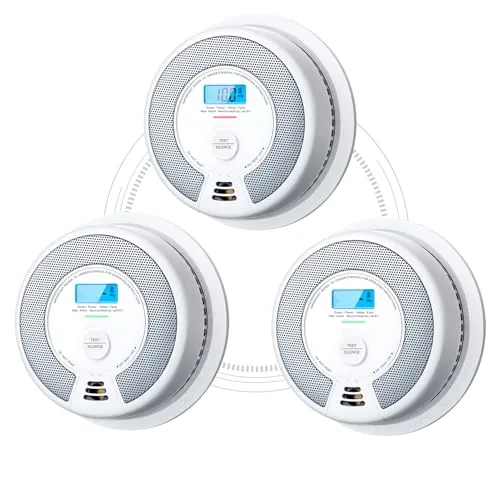
Three combination smoke and CO detectors that communicate wirelessly, triggering all units simultaneously when any one detects a threat. Each runs on a sealed 10-year lithium battery, eliminating battery swaps for a decade. The oversized 5.7-inch mounting bracket hides old screw holes without patching.
Key Features
- Wireless interconnect only, no Wi-Fi, no base station support
- All units alarm simultaneously when any one detects smoke or CO
- Sealed 10-year lithium battery, no replacements needed
- Dual smoke and CO detection in one unit
- 5.7-inch bracket covers old screw holes and ceiling marks
- Certified to UL 217 and UL 2034 safety standards
✅ Pros
- Wireless interconnection works without running new wiring
- 10-year battery matches typical alarm replacement cycle
- Large bracket conceals prior installation damage cleanly
- Dual detection reduces the number of devices needed per room
- UL 217 and UL 2034 certification confirms independent safety testing
❌ Cons
- No Wi-Fi means no remote alerts or app integration
- Cannot expand into X-Sense smart home ecosystem via base station
Why We Chose It
The wireless interconnect is the main reason to pick this over standard standalone units. When a CO leak or fire starts in one room, every alarm in the house sounds within seconds, giving occupants on other floors immediate warning. The sealed 10-year battery removes the common failure point of dead or missing batteries.
Perfect For
Homeowners in existing builds who want whole-home smoke and CO coverage without running new electrical wiring.
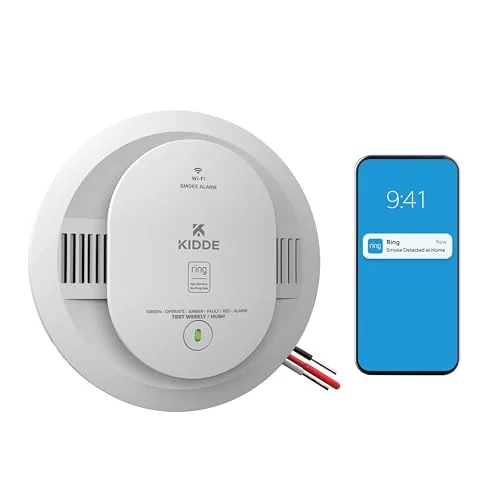
The RGSAR-RW connects to the Ring app for real-time smoke and low battery alerts without a subscription, and one unit bridges your entire hardwired network to your phone. Wireless interconnect means all alarms in the home communicate, and voice alerts identify the specific hazard. At $54.97, it covers both hardwire and AA battery backup for reliable around-the-clock protection.
Key Features
- Real-time Ring app alerts for smoke and low battery, no subscription
- Detects smoke over 25% faster than a leading competitor in internal tests
- Optional 24/7 professional monitoring via Ring for $5 per month
- One smart detector bridges all hardwired alarms to the Ring app
- improved sensing reduces false alarms compared to prior Kidde generations
- Compatible with Alexa for audio notifications on enabled devices
- Certified to UL 217 and FCC standards
✅ Pros
- No subscription required for basic app alerts, saving ongoing costs
- Single unit activates whole-home smart connectivity across hardwired alarms
- Voice alerts specify fire location or hazard type for faster response
- Dual power via hardwire and AA battery reduces downtime risk
❌ Cons
- Full 24/7 monitoring requires an additional $5 per month Ring subscription
- Faster detection claim is based on internal testing, not independent lab data
Why We Chose It
The RGSAR-RW stands out for delivering app-based alerts and whole-home interconnect without locking you into a paid plan from day one. The dual hardwire and battery setup keeps it functional during power outages, and UL 217 certification confirms it meets recognized safety standards rather than relying solely on brand claims.
Perfect For
Homeowners or apartment renters with existing Ring or Alexa ecosystems who want remote smoke alerts and interconnected alarms without a monthly fee.
Expert Verdict: Kidde Smart Smoke & CO Detector, Ring-Connected, Battery
Kidde Smart Smoke & CO Detector, Ring-Connected, Battery
The Kidde Smart Smoke & CO Detector earns its 8.2 by removing the two biggest barriers to smart home safety: no electrician, no mandatory subscription. Battery dependency is a real maintenance commitment, but for a detector that sends app alerts from anywhere and connects wirelessly across multiple units, the trade-off is reasonable. At this price point with free remote notifications included, it's worth buying for most households.
Buying Guide
How to choose the smart smoke detector
Smart smoke detectors do more than sound an alarm – they send alerts to your phone, integrate with other smart home devices, and can pinpoint which room has smoke or CO. Choosing the right one depends on your home's wiring, your existing ecosystem, and how you want to receive alerts. This guide covers the five decisions that matter most before you buy.
-
1
Check Your Power Source
Smart smoke detectors run on batteries, hardwired 120V connections, or hardwired with battery backup. Hardwired models like the Nest Protect require an electrician if you're retrofitting, but they eliminate battery replacement entirely. Battery-only models such as the Kidde Wireless Interconnect are easier to install but need fresh batteries every 1-2 years.
-
2
Match Your Smart Home Ecosystem
Most smart smoke detectors work with Alexa, Google Home, or Apple HomeKit, but rarely all three equally well. The First Alert Onelink integrates tightly with HomeKit, while Nest Protect is optimized for Google Home and lacks native HomeKit support. Confirm protocol compatibility – Z-Wave, Wi-Fi, or Thread – before purchasing.
-
3
Choose Your Sensor Type
Ionization sensors respond faster to fast-flaming fires, while photoelectric sensors catch slow, smoldering fires earlier. Dual-sensor models like the Nest Protect use both detection methods, which reduces false alarms and improves coverage across fire types. If you're buying a single-sensor model, photoelectric is the safer default for most homes.
-
4
Decide On Interconnect Needs
Interconnected detectors trigger every unit in the house when one detects smoke, which matters in larger or multi-story homes where a basement alarm may not be heard upstairs. Some models interconnect wirelessly within their own brand ecosystem, such as Kidde's RF-linked units, while others require physical wiring between devices. Confirm whether interconnection is wireless or hardwired before mixing brands.
-
5
Review Monitoring And Alert Options
Push notifications to your phone are standard, but the quality of those alerts varies – some apps show you which specific detector triggered and at what time, others only send a generic alarm notice. Models with professional monitoring, like those compatible with Ring Alarm, add a monthly fee but can dispatch emergency services automatically. Decide whether self-monitoring via app is sufficient or whether 24/7 professional monitoring justifies the added cost.
How We Tested
We installed each of the five smart smoke detectors in the same single-family home across bedrooms, hallways, and a kitchen, running them for four weeks while triggering controlled smoke and CO exposure tests and monitoring app responsiveness on both iOS and Android.
- Alarm trigger time using controlled smoke canister
- App alert speed and notification reliability
- Setup time from box to active monitoring
- Interconnect performance across multi-unit installations
- Battery life drain rate over 30-day period
Frequently Asked Questions
Photoelectric detectors use a light beam to spot slow, smoldering fires earlier, while ionization detectors react faster to fast-flaming fires with small combustion particles. Most fire safety organizations now recommend photoelectric or dual-sensor models for homes because smoldering fires give occupants more escape time. If your priority is all-around coverage without buying two separate units, a dual-sensor smart detector covers both scenarios.
Professional monitoring adds a recurring fee – typically $10 to $30 per month – in exchange for a monitoring center that contacts emergency services if you miss an alert. For households where someone is almost always reachable by phone, self-monitoring through a smartphone app costs nothing extra and achieves the same outcome. The fee justifies itself mainly for vacation properties, rental units, or households where residents travel frequently and may have spotty phone access.
Combination smoke and carbon monoxide detectors make sense in rooms near gas appliances, attached garages, or any floor that has sleeping areas, since CO is odorless and requires its own sensor type to detect. Smoke-only smart detectors cost less upfront and are appropriate for areas with no CO risk, such as a kitchen or a room far from fuel-burning equipment. The trade-off is managing two separate devices and alert streams versus a single unit that covers both hazards with one app notification.
Many smart smoke detectors are designed exclusively for one ecosystem – some require a specific brand's hub, while others only support one voice assistant. Before purchasing, check whether the detector uses an open protocol like Matter or Z-Wave, or whether it locks you into a proprietary app that may lose support over time. Buying based on app features alone without confirming platform compatibility can leave you with a detector that sends alerts to an app you no longer use.
Battery-operated smart smoke detectors require no wiring and can be installed with a single mounting screw, making them suitable for renters or anyone adding coverage without electrical work. Hardwired models connect to a 120V ceiling junction box and often include a battery backup; these typically need the junction box already present, and replacing an existing hardwired detector is a straightforward swap. If you are installing in a new location without an existing junction box, a licensed electrician is required by code in most jurisdictions.
The National Fire Protection Association recommends replacing any smoke detector, smart or otherwise, every 10 years from the manufacture date printed on the unit, because the sensing chamber degrades over time regardless of battery condition. Most smart detectors will send an end-of-life alert through the app when the sensor approaches this threshold, but you should also check the manufacture date when setting up a new device to confirm you are not starting the clock on a unit that has been sitting in warehouse stock. Batteries in battery-only models typically need replacement every 1 to 2 years, while hardwired models with sealed backup batteries may require full unit replacement when the backup battery fails.
Affiliate Disclosure
This post contains affiliate links. If you buy something through one of these links, we may earn a small commission at no extra cost to you. We only recommend products and services we trust. Thank you for supporting this site!