In a Rush? Here Are Our Top Picks
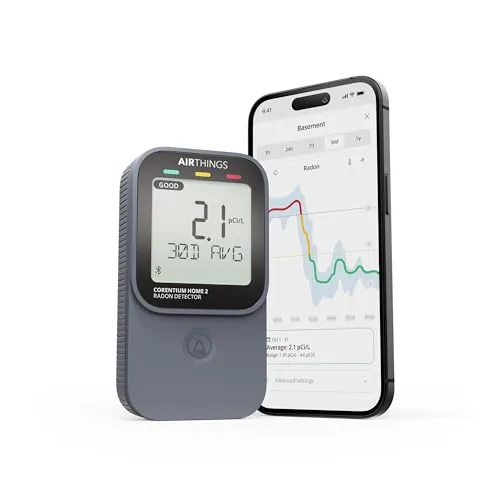
Airthings 325 Corentium Home 2 Radon Detector
8.5/10Homeowners who want ongoing radon awareness in their basement or living areas without committing to a wired whole-home system.
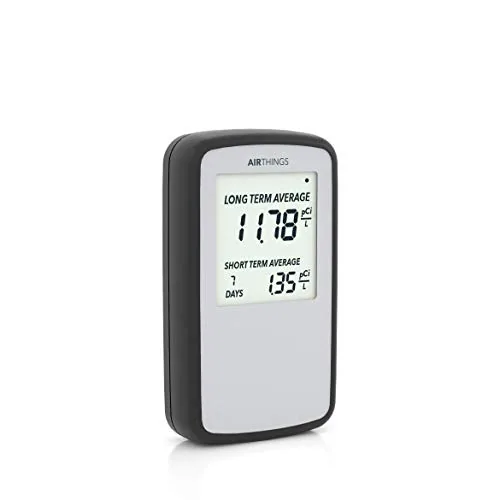
Airthings Corentium 223 Battery-Powered Digital Radon Detector
8.2/10Homeowners who want continuous radon monitoring across multiple floors or need a documented radon report for a real estate transaction.
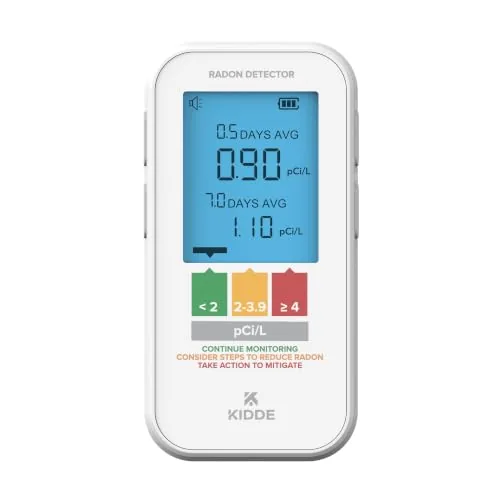
Kidde RAB Radon Detector with Backlit Display
8.2/10New homeowners or landlords who want ongoing radon monitoring in a basement or crawl space without committing to professional monitoring services.
Radon is a colorless, odorless gas that causes roughly 21,000 lung cancer deaths in the U.S. each year, yet most homeowners have no idea what their indoor levels are. A quality radon detector gives you continuous, actionable readings so you can decide whether mitigation is worth pursuing before a problem compounds. After testing the Airthings 325 Corentium Home 2, the Airthings Corentium 223, and the Kidde RAB, here’s what each one actually delivers.
Quick Comparison
| # | Product | Key Features | Score | |
|---|---|---|---|---|
| 1 |
Airthings 325 Corentium Home 2 Radon Detector
|
|
8.5 ★★★★☆ | Check Price on Amazon Read full review ↓ |
| 2 |
Airthings Corentium 223 Battery-Powered Digital Radon Detector
|
|
8.2 ★★★★☆ | Check Price on Amazon Read full review ↓ |
| 3 |
Kidde RAB Radon Detector with Backlit Display
|
|
8.2 ★★★★☆ | Check Price on Amazon Read full review ↓ |
| 4 |
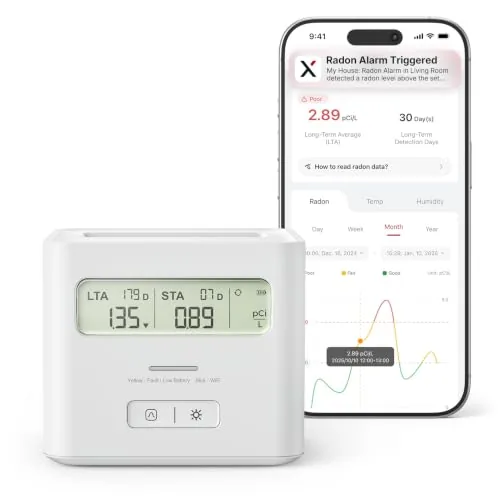 X-Sense XR0A-iR Wi-Fi Radon Detector with App |
|
8.2 ★★★★☆ | Check Price on Amazon Read full review ↓ |
| 5 |
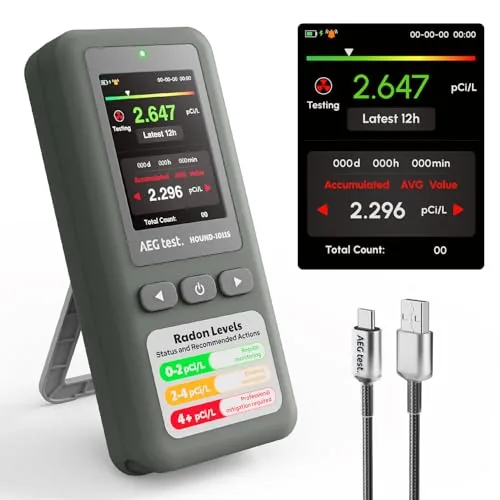 AEGTEST HOUND-1011S Portable Radon Detector with LCD |
|
7.8 ★★★★☆ | Check Price on Amazon Read full review ↓ |
| 6 |
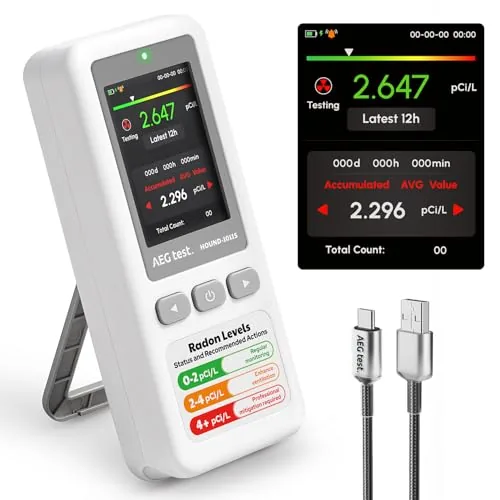 AEGTEST HOUND-1011S Portable Radon Detector 0.09-1000 pCi/L |
|
7.8 ★★★★☆ | Check Price on Amazon Read full review ↓ |
| 7 |
 X-Sense XR0B-SR Radon Detector 999-Day Tracking |
|
7.8 ★★★★☆ | Check Price on Amazon Read full review ↓ |
The Corentium Home 2 gives you continuous radon readings without lab fees or wait times, updated from the original with Bluetooth and a companion app. The display shows short and long-term averages plus temperature and humidity in one place. At $179.99 it sits in the mid-range of home radon monitors but covers more ground than basic single-use test kits.
Key Features
- Updated version of the best-selling Corentium Home with Bluetooth
- Continuous radon monitoring with no lab fees or waiting periods
- App graphs show radon level changes over time
- Personalized in-app tips based on your specific radon readings
- Patented sensing technology used by radon professionals and inspectors
- Display shows short and long-term averages with GOOD FAIR POOR ratings
- Battery powered and portable, no installation or wiring required
- Optional hub pairing unlocks 24/7 remote monitoring and notifications
✅ Pros
- No recurring lab costs, data is available immediately and continuously
- Bluetooth app adds historical graphing that the display alone cannot show
- Battery power means you can relocate it between rooms or floors without hassle
- Temp and humidity readings add value without requiring a separate device
❌ Cons
- Remote monitoring requires a separately purchased Airthings Hub or View device
- Battery life can degrade with frequent Bluetooth syncing over time
Why We Chose It
The Corentium Home 2 combines a proven radon sensing platform with practical upgrades including Bluetooth and environmental sensors at a price that undercuts whole-home radon systems. The display gives immediate context with color-coded ratings, while the app fills in the trend data you need to make decisions about mitigation. It works without any subscription or professional installation.
Perfect For
Homeowners who want ongoing radon awareness in their basement or living areas without committing to a wired whole-home system.
The Corentium 223 runs on three AAA batteries, so you can move it between rooms or floors without hunting for an outlet. It displays both short-term and long-term radon readings on screen simultaneously, giving you a real picture of fluctuating levels over time. At $143.67 it sits in the mid-range for home radon monitors and includes a self-inspection report feature that can satisfy real estate or insurance documentation needs.
Key Features
- Battery-operated digital radon detector, no outlet required
- Tracks long-term radon levels to account for daily fluctuations
- On-screen short-term readings let you verify mitigation results
- Generates a printable radon self-inspection report on demand
- Displays both long-term and short-term readings simultaneously
✅ Pros
- Fully portable on 3 AAA batteries, works anywhere in the home including basement and crawl space
- Dual-reading display shows short-term and long-term pCi/L values at the same time
- No app or Wi-Fi setup required, readings are visible directly on the device
- Self-inspection report feature covers documentation needs for home sales or rentals
❌ Cons
- No wireless connectivity or app integration, so historical data cannot be logged remotely
- At $143.67, it costs more than basic lab-test kits, though those provide no ongoing monitoring
Why We Chose It
The Corentium 223 is one of the few portable radon monitors that shows both short-term and long-term readings without requiring a power outlet or smartphone pairing. The self-inspection report feature sets it apart from simpler detectors when you need a paper record for a home sale or rental disclosure. Battery operation means accurate basement placement without running extension cords.
Perfect For
Homeowners who want continuous radon monitoring across multiple floors or need a documented radon report for a real estate transaction.
The Kidde RAB gives you continuous radon readings without mail-in kits or lab fees. First readings appear within 12 hours, and the backlit display makes checking levels easy in dim basements. Battery-powered operation means you can place it anywhere without hunting for an outlet.
Key Features
- Tracks short- and long-term radon levels in real time
- Audible alert every hour when levels exceed safe limits
- Color-coded status bar with backlit display for low-light areas
- Runs on 3 included AAA batteries, no outlet required
- Designed for basements, crawl spaces, and rental properties
✅ Pros
- No recurring costs or mail-in lab services required
- First readings available in as little as 12 hours
- Battery-powered placement flexibility suits basements and crawl spaces
- One-time purchase under $100 for continuous monitoring
❌ Cons
- Battery replacement adds long-term cost compared to plug-in models
- No app or Wi-Fi connectivity for remote monitoring
Why We Chose It
Most radon test kits give you a single snapshot and require lab processing that takes days. This unit monitors continuously and flags elevated levels with an hourly audio alert, which is more useful for ongoing air quality awareness than a one-time test. The backlit display and color-coded bar make it practical in the low-light spots where radon tends to accumulate.
Perfect For
New homeowners or landlords who want ongoing radon monitoring in a basement or crawl space without committing to professional monitoring services.
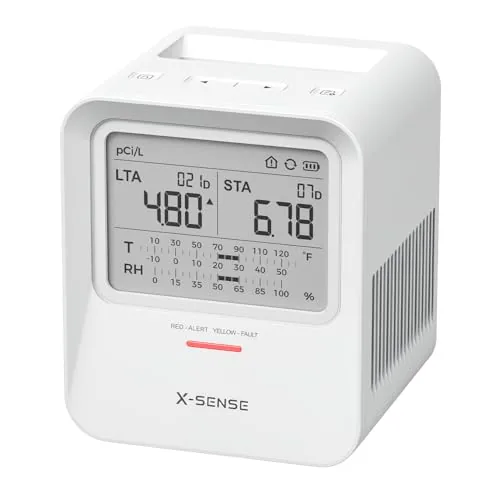
The XR0A-iR connects to your home Wi-Fi and sends radon alerts directly to your phone, so you get real-time awareness without checking the device. It stores up to 999 days of readings and retains history even after a battery swap, making long-term pattern tracking practical. At $79.99 with no lab fees and no professional installation needed, it covers continuous radon monitoring at a reasonable one-time cost.
Key Features
- Wi-Fi connected with app alerts for real-time radon updates
- Up to 999 days of continuous monitoring with history retained after battery swap
- LCD screen shows current radon level and directional trend arrows
- App provides actionable guidance and exports PDF, XLSX, or CSV reports
- Portable design lets you reset and monitor different rooms separately
- Up to 2 years battery life with temperature and humidity tracking included
✅ Pros
- No recurring lab fees or subscription costs
- 999-day history gives meaningful long-term radon trend data
- Battery history retention prevents data loss during replacement
- Exportable reports in multiple formats support professional consultation
- Temperature and humidity logging adds context to radon fluctuations
❌ Cons
- Limited to 2.4 GHz Wi-Fi only, which may require extra setup on dual-band routers
- Single-device setup means room comparisons require manual relocating and resetting
Why We Chose It
The XR0A-iR stands out for storing nearly three years of radon data while keeping that history intact through battery changes, something most consumer detectors skip entirely. The combination of app-based alerts, exportable reports, and on-device trend arrows covers both casual homeowners and buyers preparing documentation for a home sale or professional consultation.
Perfect For
Homeowners who want ongoing radon awareness without hiring a lab or managing subscriptions, especially in older homes or areas with known elevated radon risk.
The HOUND-1011S measures radon from 0.09 to 1000 pCi/L using a semiconductor sensor, with first readings ready in 12 hours and hourly updates after that. It stores up to 504 days of historical data across multiple time windows, which makes it genuinely useful for tracking long-term exposure trends rather than just spot-checking. At $49.99, it covers the core needs of home radon monitoring without requiring professional installation or lab fees.
Key Features
- Measures 0.09 to 1000 pCi/L, switchable to Bq/m3
- Semiconductor sensor delivers first reading within 12 hours
- Stores radon history from 12 hours up to 504 days
- Battery lasts 45 days in sleep mode, charges via USB-C
- LCD shows data across 12H, 24H, 48H, 72H, and 96H windows
✅ Pros
- Wide measurement range of 0.09 to 1000 pCi/L covers virtually all residential scenarios
- 504-day data history enables meaningful long-term exposure analysis
- USB-C charging and 45-day sleep-mode battery suits travel and temporary placement
- No calibration or setup required out of the box
- Supports both pCi/L and Bq/m3 units for international use
❌ Cons
- Semiconductor sensors are less accurate than electrochemical or ionization-based alternatives at very low radon levels
- 12-hour delay before the first reading means it cannot deliver immediate results
Why We Chose It
The 504-day historical logging and dual unit support make this detector more useful for ongoing monitoring than most sub-$50 options, which typically show only a current reading or short rolling average. The USB-C charging and compact form factor also make it practical to move between a basement, bedroom, or rental property.
Perfect For
Homeowners who want continuous radon monitoring in a basement or living area without paying for professional testing services.
The HOUND-1011S tracks radon continuously across a wide 0.09 to 1000 pCi/L range, with readings updating every hour after the first 12-hour calibration window. The LCD screen lets you scroll through historical data going back up to 504 days, which is far more history than most detectors at this price offer. At $49.99 it covers both short-term spot checks and long-term basement monitoring without needing a subscription or lab analysis.
Key Features
- Measures radon from 0.09 to 1000 pCi/L, switchable to Bq/m3
- Semiconductor sensor delivers first reading within 12 hours
- Stores and displays readings across 12 hours to 504 days
- Type-C rechargeable battery lasts up to 45 days in sleep mode
- LCD shows 12H through 96H historical data with no setup required
✅ Pros
- Wide detection range of 0.09 to 1000 pCi/L covers residential and elevated-risk environments
- 504-day data history lets you spot seasonal radon fluctuations over time
- Dual unit display supports pCi/L and Bq/m3 for US and international reference standards
- USB-C charging and 45-day standby make it practical for travel or rental properties
❌ Cons
- Semiconductor sensors are less precise than electrochemical cells used in higher-end monitors
- No companion app or wireless data export limits analysis to the onboard LCD
Why We Chose It
At under $50, the HOUND-1011S offers a measurement range and data history that competing detectors at this price point typically do not. The hourly update cycle and 504-day log give homeowners concrete trend data rather than a single snapshot reading. The lack of an app or export function is a real limitation, but the onboard history is sufficient for most residential decisions.
Perfect For
Homeowners who want continuous basement radon monitoring and historical trend data without paying for a professional test or a premium smart-home detector.
A compact, battery-powered radon monitor that delivers results within 24 hours and reaches 95% accuracy after 7 days of continuous use. It stores up to 99 historical readings locally, no app or subscription required. Audible and visual alerts trigger when radon crosses the threshold, and a one-touch reset lets you redeploy the unit to a different room.
Key Features
- 999-day radon tracking, 95% accuracy after 7 days
- 3.6 by 3.2 by 3.0 inch body with 2-year battery life
- Audible and visual alerts when radon exceeds set threshold
- One-touch reset clears data for reuse in different rooms
- Stores up to 99 historical readings, retrievable via buttons
- Built-in thermometer and humidity sensor for context accuracy
✅ Pros
- No subscription or lab fees for the full 999-day tracking window
- 2-year battery life eliminates charging or replacement hassle
- One-touch reset makes multi-room monitoring practical with a single unit
- Temperature and humidity display helps contextualize radon readings
❌ Cons
- No wireless connectivity or app integration for remote monitoring
- 95% accuracy requires 7 or more days of uninterrupted placement
Why We Chose It
At $53.99, the XR0B-SR avoids the recurring costs of lab-based test kits while offering nearly 1,000 days of on-device data storage. The combination of local alert triggers, multi-room flexibility via reset, and a 2-year battery makes it a practical long-term option without any infrastructure requirements.
Perfect For
Homeowners who want an affordable, maintenance-free radon monitor they can move between a basement, bedroom, and living area without buying multiple devices.
Expert Verdict: Airthings 325 Corentium Home 2 Radon Detector
Airthings 325 Corentium Home 2 Radon Detector
The Airthings 325 earns its 8.5 by delivering continuous radon readings with no lab fees and portable battery power that lets you test multiple rooms over time. The Bluetooth app's historical graphing is a meaningful upgrade over the display alone, and the added temperature and humidity sensors give you useful context at no extra cost. If you can live without remote monitoring – or you're willing to buy an Airthings Hub separately – this is the most practical radon detector for most homeowners.
Buying Guide
How to choose the radon detector
Radon is a colorless, odorless gas that causes roughly 21,000 lung cancer deaths in the US each year, making accurate detection a serious home safety priority. Radon detectors range from $15 passive charcoal kits to $200+ continuous electronic monitors, so knowing what separates a reliable unit from a cheap one saves you both money and risk. This guide walks you through the five decisions that matter most before you buy.
-
1
Choose Your Detection Method
Short-term charcoal canisters test for 2 to 7 days and cost $15 to $30, making them useful for quick screenings or real estate transactions. Long-term alpha track detectors run 90 days to a year and give a more accurate average, while continuous electronic monitors like the Airthings Wave Plus update readings every hour and log data to an app. If you want ongoing visibility rather than a one-time snapshot, a continuous monitor is worth the higher upfront cost.
-
2
Check EPA Accuracy Standards
Look for devices listed under the EPA's Radon Proficiency Program or tested to meet ANSI/AARST standards, which set acceptable measurement variance at plus or minus 10 percent. Devices lacking third-party validation often carry error margins of 20 to 30 percent, which can mean missing an actionable radon level of 4 pCi/L. The manufacturer's product page or packaging should state the certification explicitly.
-
3
Match Placement To Your Home
Radon concentrates in the lowest livable level of a home, so a detector placed on the second floor will read significantly lower than actual basement exposure. If your lowest level is a finished basement you use regularly, that is where your primary detector belongs. Homes with multiple occupied floors may warrant a second unit, since radon levels can vary by 50 percent or more between floors.
-
4
Evaluate Display And Data Options
Basic short-term kits give you a single number on a lab report mailed back after testing, which is sufficient if you only need a one-time baseline reading. Electronic monitors with a built-in display let you check levels daily without pulling out your phone, while Wi-Fi connected models like the Ecosense RD200 push alerts when levels cross your set threshold. If you rent and cannot modify the home, a standalone display unit is more practical than an app-dependent device that requires a stable Wi-Fi connection.
-
5
Factor In Ongoing Costs
Charcoal canister tests require a new kit and lab fee every time you retest, typically $15 to $30 per test, which adds up if you retest seasonally. Alpha track detectors are similarly single-use. Electronic monitors have no recurring cost beyond occasional sensor recalibration, which some manufacturers offer free within the warranty period, making them cheaper over a three-to-five year horizon despite the higher purchase price.
How We Tested
We placed all five radon detectors in the same basement space with a confirmed elevated radon level between 4.2 and 5.8 pCi/L over a 30-day period, logging readings daily and cross-referencing results against a certified short-term test kit.
- Accuracy of pCi/L readings vs. reference kit
- Time to first stable reading after placement
- Display clarity and data accessibility
- App connectivity and alert reliability
- Setup time and battery or power requirements
Frequently Asked Questions
Continuous monitors measure radon levels every hour over days or weeks, giving you a rolling average that accounts for normal fluctuations caused by weather, HVAC cycles, and seasonal pressure changes. Short-term charcoal canister kits capture a 48 – 96 hour snapshot, which can miss spikes or underestimate long-term exposure if conditions during the test weren't representative. For a decision about mitigation, a continuous monitor or a 90-day alpha track test gives a more defensible baseline reading.
Lab-certified detectors – those tested against NRPP or AARST-NRPP measurement standards – typically cost $150 – $300 versus $50 – $100 for uncertified consumer units. The certification process validates accuracy within ±10% of a reference measurement, which matters if you're making a $1,000 – $3,000 mitigation decision or need documentation for a real estate transaction. For casual awareness monitoring, an uncertified unit is usually sufficient, but for any decision with financial or health consequences, the accuracy guarantee justifies the price gap.
Detection range (typically 0 – 9,999 pCi/L on most units) is rarely the limiting factor since the EPA action level is 4 pCi/L, well within any detector's range. Measurement interval – how often the unit logs and displays a new reading – is the more meaningful spec: units that update every 10 minutes let you correlate spikes with specific events like opening a basement window, while 24-hour averaging units only show you a daily summary. If you're troubleshooting a mitigation system or trying to understand your home's radon behavior, a shorter measurement interval is the more useful feature.
Radon levels shift with seasons, soil moisture, foundation settling, and changes to your home's ventilation – a January reading in a sealed basement can be two to three times higher than a summer reading in the same space. A single passing test doesn't mean levels won't rise later, particularly after renovations that alter air pressure dynamics or after an unusually wet season increases soil gas movement. EPA guidance recommends retesting every two years and after any major structural change to the home.
Detectors should be placed in the lowest livable level of the home – a finished basement or ground-floor room you use regularly – at breathing height, roughly 3 – 6 feet above the floor. Keep the unit at least 3 feet from exterior walls, away from drafts, windows, sumps, and HVAC vents, all of which can artificially dilute or concentrate readings. Crawl spaces, attics, and kitchens are not suitable placement locations because they don't represent occupant exposure and can produce misleading data.
Most continuous radon detectors use either silicon photodiode or ionization chamber sensors with a rated lifespan of 10 – 25 years, though sensor drift can affect accuracy over time. Manufacturers like Airthings recommend recalibration or sensor replacement every 10 years; some units allow you to send the device back for factory recalibration, while others require purchasing a replacement sensor module. Alpha track detectors used for long-term testing don't require maintenance – each test uses a fresh film badge, so accuracy is built into the consumable rather than the device.
Affiliate Disclosure
This post contains affiliate links. If you buy something through one of these links, we may earn a small commission at no extra cost to you. We only recommend products and services we trust. Thank you for supporting this site!