In a Rush? Here Are Our Top Picks
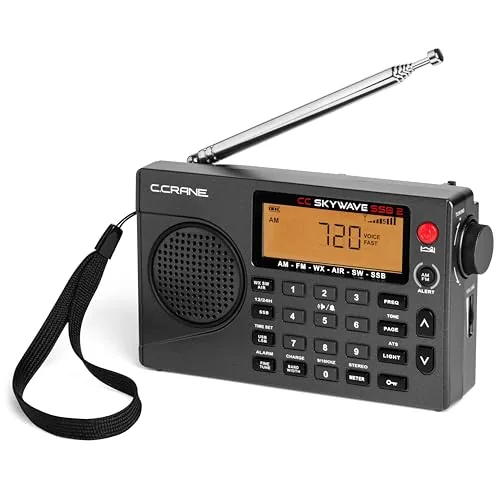
C.Crane CC Skywave SSB 2 Portable Multiband Radio with SSB
8.5/10Preppers, frequent travelers, and amateur radio listeners who need a compact all-band receiver that works when infrastructure fails.
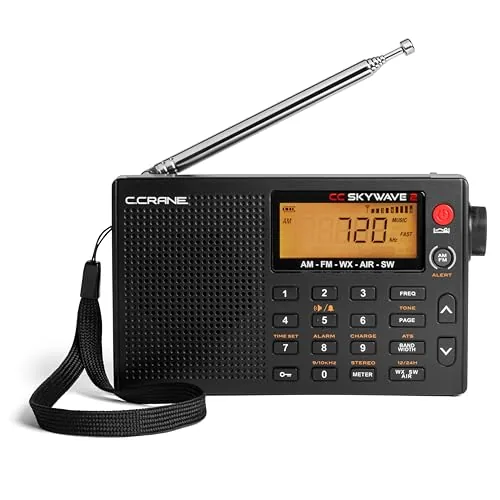
C.Crane CC Skywave 2 Multiband Portable Travel Radio
8.5/10Travelers and preparedness-minded listeners who want a single compact radio covering broadcast, weather alerts, shortwave, and aviation monitoring.
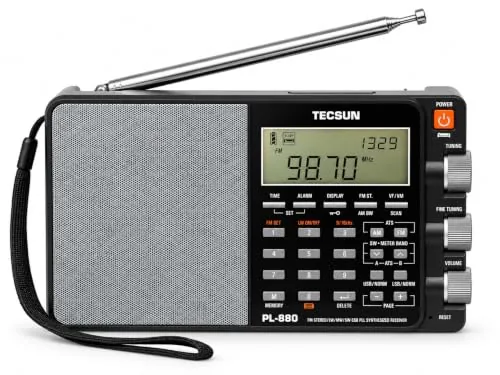
Tecsun PL880 Portable SSB Shortwave Radio
8.5/10Shortwave enthusiasts and amateur radio listeners who want a capable portable receiver for travel, field use, or home listening without buying a desktop unit.
Shortwave radios pull in AM, FM, weather, aviation, and international broadcasts on a single device – useful whether you’re preparing for emergencies, traveling internationally, or just want access to radio signals your phone can’t touch. The three models worth your time right now are the C.Crane CC Skywave SSB 2, the C.Crane CC Skywave 2, and the Tecsun PL880, each targeting a slightly different buyer depending on how much you’ll use SSB tuning and what you’re willing to spend. This guide breaks down what separates them so you can pick the right one without overpaying for features you won’t use.
Quick Comparison
| # | Product | Key Features | Score | |
|---|---|---|---|---|
| 1 |
C.Crane CC Skywave SSB 2 Portable Multiband Radio with SSB
|
|
8.5 ★★★★☆ | Check Price on Amazon Read full review ↓ |
| 2 |
C.Crane CC Skywave 2 Multiband Portable Travel Radio
|
|
8.5 ★★★★☆ | Check Price on Amazon Read full review ↓ |
| 3 |
Tecsun PL880 Portable SSB Shortwave Radio
|
|
8.5 ★★★★☆ | Check Price on Amazon Read full review ↓ |
| 4 |
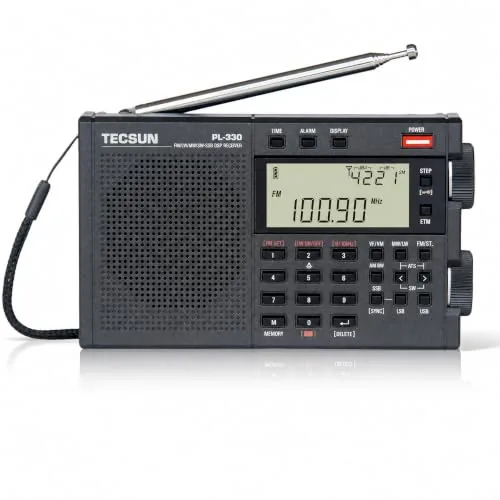 Tecsun PL330 AM/FM/LW/SW/SSB Worldband Radio |
|
8.2 ★★★★☆ | Check Price on Amazon Read full review ↓ |
| 5 |
 Kaito KA500 6-Way Powered Emergency Weather Radio |
|
8.2 ★★★★☆ | Check Price on Amazon Read full review ↓ |
| 6 |
 ZHIWHIS A330 SSB Shortwave Radio with Full-Band Scanner |
|
8.2 ★★★★☆ | Check Price on Amazon Read full review ↓ |
| 7 |
 Tecsun S-2200 SSB World Band DSP Radio Receiver |
|
8.2 ★★★★☆ | Check Price on Amazon Read full review ↓ |
| 8 |
 Emgykit R11 Solar Hand Crank Emergency Radio with Bluetooth |
|
7.8 ★★★★☆ | Check Price on Amazon Read full review ↓ |
| 9 |
 DreamSky AM/FM/SW Portable Radio with Digital Display |
|
7.5 ★★★★☆ | Check Price on Amazon Read full review ↓ |
A 6-ounce radio covering AM, FM, shortwave with SSB, NOAA weather alerts, and VHF aviation band in a 4.75 by 3 inch frame. Single sideband reception lets you pull in long-range communications when cell and internet infrastructure is down. At under 190 dollars, it packs serious off-grid utility into a package smaller than most paperback books.
Key Features
- Covers AM, FM, shortwave SSB, NOAA weather alert, and VHF airband
- Digital tuning with selectable bandwidth and fast or fine tuning modes
- Direct frequency entry, auto scan, and 400 memory slots including 10 aviation
- External shortwave antenna jack included with 23 ft reel antenna
- 70-hour battery life on earbuds, 60 hours on built-in speaker using 2 AA batteries
- Weighs 6 oz without batteries, measures 4.75 by 3 by 1.1 inches
✅ Pros
- SSB reception covers amateur and utility frequencies unavailable on smartphones
- 70-hour runtime on two AA batteries makes it viable for extended emergencies
- Scannable aviation band adds situational awareness most portable radios omit
- Included 23 ft reel antenna and carry case add real value at this price point
❌ Cons
- No AC adapter in the box, sold separately, which is an oversight at 190 dollars
- SSB fine-tuning can require patience for newcomers unfamiliar with the mode
Why We Chose It
The CC Skywave SSB 2 covers more frequency territory than any comparably sized portable radio, including aviation band and single sideband that most travel radios skip entirely. The 70-hour battery runtime and pocket-sized form factor make it a credible emergency backup rather than a hobbyist novelty.
Perfect For
Preppers, frequent travelers, and amateur radio listeners who need a compact all-band receiver that works when infrastructure fails.
The CC Skywave 2 covers AM, FM, shortwave, NOAA weather with alert, and VHF aviation band in a 6-ounce package that runs 60 to 70 hours on two AA batteries. Multiple bandwidth settings and selectable tuning speed give you real control over reception quality rather than relying on a single fixed filter. At $109.99 it sits in a crowded field, but the aviation band and external shortwave antenna jack are rare at this size and price.
Key Features
- Covers AM, FM, shortwave, NOAA weather alert, and VHF aviation band
- Digitally tuned with multiple bandwidth settings and selectable tuning speed
- Direct frequency entry, auto scan, 400 memories, 10 scannable aviation memories
- External shortwave antenna jack for improved shortwave reception
- 70-hour battery life on earbuds, 60 hours on built-in speaker
- Measures 4.75 x 3 x 1.1 inches, weighs 6.0 oz without batteries
- Includes carry case, earphones, fold-out stand, and stereo headphone jack
✅ Pros
- VHF aviation band is uncommon in radios this compact
- Multiple bandwidth settings meaningfully improve selectivity on crowded bands
- 60 to 70 hours on two AA batteries reduces dependency on charging
- External antenna jack extends shortwave usefulness beyond built-in whip
- US-based tech support and one-year warranty back the purchase
❌ Cons
- Weather band does not support selectable tuning speed like other bands
- No built-in rechargeable battery requires sourcing an optional USB adapter separately
Why We Chose It
The CC Skywave 2 covers more band types than most travel radios its size, and the combination of multiple bandwidth filters with selectable tuning speed puts reception control in your hands. The aviation band lets you monitor approach and departure frequencies, which is genuinely useful for enthusiasts and situational awareness during travel. Build quality and C.Crane’s support reputation make this a lower-risk buy in a category full of no-name hardware.
Perfect For
Travelers and preparedness-minded listeners who want a single compact radio covering broadcast, weather alerts, shortwave, and aviation monitoring.
The PL880 covers AM, FM, longwave, and shortwave bands with SSB capability, making it one of the most complete portable receivers under $200. Dual conversion architecture and four selectable bandwidth filters on AM give it strong interference rejection in crowded band conditions. The 10 Hz SSB tuning step lets you resolve voice and CW signals with precision most radios at this price skip entirely.
Key Features
- Full band coverage: AM, FM, longwave, and shortwave with SSB
- Dual conversion PLL receiver with high sensitivity and selectivity
- 4 AM bandwidth filters and 5 SSB filters with 10 Hz tuning steps
- Sleep timer adjustable from 0 to 120 minutes plus alarm clock
- One-year USA warranty included
✅ Pros
- SSB reception with 10 Hz fine-tuning is rare at this price point
- Dual conversion design reduces image interference on shortwave bands
- Multiple bandwidth filters let you trade audio quality for selectivity as needed
- Compact form factor works for travel and portable outdoor use
❌ Cons
- No rechargeable battery built in, so you depend on external AA cells or a separate charger
- Learning the full filter and mode controls takes time without prior radio experience
Why We Chose It
The PL880 delivers dual conversion circuitry and SSB support in a handheld package, which separates it from basic shortwave portables that top out at AM and FM. The combination of selectable bandwidth filters and 10 Hz SSB stepping gives it enough precision for amateur radio monitoring and utility station work, not just casual broadcast listening.
Perfect For
Shortwave enthusiasts and amateur radio listeners who want a capable portable receiver for travel, field use, or home listening without buying a desktop unit.
The PL330 covers AM, FM, longwave, shortwave, and single sideband in a compact portable form. DSP demodulation improves signal clarity across all bands, which matters most on crowded shortwave frequencies. At $84.98 it sits in a practical middle ground between budget travel radios and full ham-shack receivers.
Key Features
- Covers AM, FM, longwave, shortwave, and single sideband
- DSP digital demodulation with synchronous detection reduces interference
- 8-ohm 250mW speaker with 3.5mm stereo earphone jack included
- 850 memory slots, alarm clock, 120-minute sleep timer, keylock
- Ships with firmware version 3307
✅ Pros
- Single sideband reception is rare at this price point
- 850 station memories reduce manual tuning on frequent listening sessions
- DSP synchronous detection handles adjacent-channel interference better than analog designs
- Stereo earphones included out of the box
❌ Cons
- 250mW speaker output is adequate indoors but not loud in noisy environments
- No built-in rechargeable battery, depending on AA cells or external power
Why We Chose It
The PL330 earns its place because SSB support at under $90 is genuinely uncommon, making it useful for utility stations, amateur radio listening, and international broadcasts that use LSB or USB modes. The updated DSP firmware improves selectivity compared to earlier Tecsun portable models, reducing the bleed-through from strong adjacent stations that plagues cheaper shortwave sets.
Perfect For
Shortwave hobbyists and travelers who want full-band coverage including SSB without spending on a tabletop receiver.
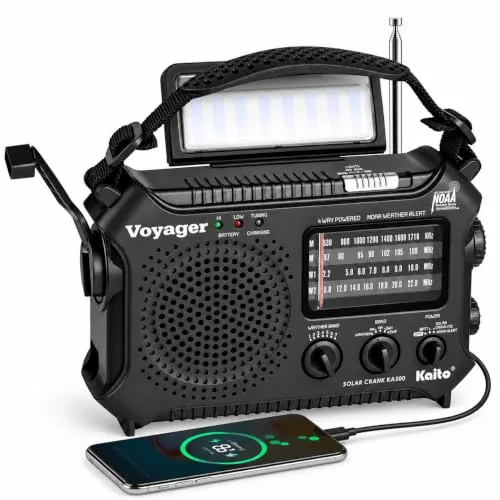
The KA500 covers AM, FM, shortwave, and all seven NOAA weather channels, giving you reliable access to emergency alerts and global broadcasts without depending on grid power. Six charging methods include solar, hand crank, AA batteries, USB input, AC adapter, and a built-in NiMH pack. A USB output port lets you charge phones and GPS units directly from the radio.
Key Features
- Six power sources including solar, crank, AA, USB, AC, and NiMH pack
- AM, FM, two-band shortwave, and seven pre-programmed NOAA weather channels
- USB output port charges phones, GPS units, and cameras
- 5-LED reading lamp, LED flashlight, and red SOS beacon included
- 14.5-inch telescopic antenna with LED signal strength indicator
- Impact-resistant and water-resistant ABS housing for indoor and outdoor use
✅ Pros
- Six independent power sources make it reliable when infrastructure fails
- NOAA weather alert system with PEAS covers both USA and Canada
- USB charging output adds real utility beyond just receiving broadcasts
- Built-in NiMH pack is user-replaceable, not sealed inside the unit
❌ Cons
- Wall power adapter sold separately despite AC input being listed as a feature
- Hand crank charging is slow and best treated as a last resort, not a primary power method
Why We Chose It
Most emergency radios stop at three or four power options, but the KA500 covers six, including a replaceable NiMH battery pack that can be swapped out rather than discarded when it degrades. The combination of shortwave coverage and NOAA PEAS alerts makes it more capable than weather-only radios at a similar price point.
Perfect For
Campers, preppers, and households in regions prone to severe weather who want a single compact device covering power outages, emergency alerts, and basic off-grid communication.
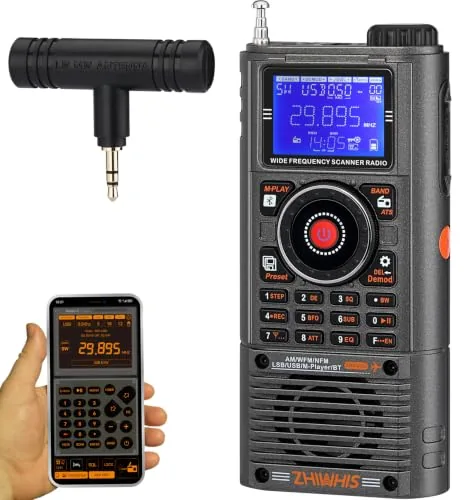
The A330 covers an unusually wide frequency range, from FM and mediumwave through shortwave, VHF, UHF, airband, and CB, making it one of the more versatile portable receivers at this price point. SSB support with BFO adjustment lets you tune ham radio operators and utility stations that AM-only radios miss entirely. Bluetooth 5.2, a TF card slot, and app-based remote control add modern convenience without inflating the price beyond $90.
Key Features
- FM, MW, SW 2.3-30MHz, AIR, CB, VHF, UHF, and WB reception
- SW mode decodes AM, LSB, and USB with BFO fine-tuning
- 3.5mm external antenna port for improved sensitivity
- 200-station memory per band with manual, auto, and keypad entry
- Bluetooth 5.2, TF card slot, PC playback, and app remote control
- Six EQ presets, squelch, BW, demodulation, and sleep timer settings
- STN LCD with blue backlight and wide viewing angle
- Separate physical knobs for volume and tuning
✅ Pros
- SSB with BFO adjustment is rare under $100 and opens up ham and utility bands
- Frequency coverage spans eight band types including airband 118-138MHz
- 200-memory slots per band is generous for a handheld receiver
- Bluetooth 5.2 and app control reduce the need to handle the unit while listening
❌ Cons
- ZHIWHIS is a newer brand with limited long-term reliability data
- STN LCD is functional but lower contrast than IPS or OLED displays common on pricier units
Why We Chose It
At $89.77, the A330 delivers SSB demodulation with BFO control alongside eight band types, a combination that competitors typically price $30 to $50 higher. The physical dual-knob layout keeps tuning tactile and fast, which matters during shortwave band scanning. Bluetooth 5.2 and app remote push it beyond pure utility into everyday usability.
Perfect For
Shortwave hobbyists and scanner enthusiasts who want SSB capability and wide frequency coverage without spending over $100.
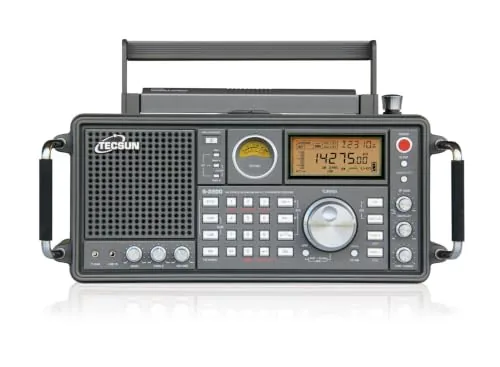
The S-2200 covers AM, FM, longwave, shortwave, SSB, and VHF airband in a single desktop unit, making it one of the most frequency-complete receivers available under $500. Dual tuning knobs let you sweep bands quickly or lock onto a precise frequency, and dedicated external antenna jacks for FM, SW, and airband give you a real upgrade path as your setup grows. At $479.99, this targets hobbyists who want a permanent shack radio rather than a portable listening device.
Key Features
- Receives AM, FM, LW, SW, and VHF airband frequencies
- Independent USB and LSB modes with BFO fine-tuning control
- DSP chipset improves sensitivity, selectivity, and interference rejection
- Dual tuning knobs for fast scanning and precise frequency isolation
- Backlit LCD screen readable in low-light conditions
- Internal speaker with separate external antenna jacks for FM, SW, airband
- North American edition tuned for US and Canada frequency standards
✅ Pros
- Six band types including VHF airband in one receiver is uncommon at this price
- SSB with BFO covers ham radio, maritime weather, and two-way monitoring
- External antenna inputs on multiple bands allow meaningful reception upgrades
- DSP processing reduces manual filtering work during crowded band conditions
- North American frequency calibration avoids the retuning required with grey-market imports
❌ Cons
- At $480 it competes with SDR-based setups that offer wider software flexibility
- Desktop-only form factor rules out portable or field use
Why We Chose It
The S-2200 stands out because it combines SSB capability, VHF airband monitoring, and external antenna support in a purpose-built desktop chassis rather than a handheld compromise. The North American edition removes the frequency mismatch issues common with imported Tecsun models, which matters for AM and FM band alignment.
Perfect For
Shortwave hobbyists and ham radio listeners who want a dedicated desktop receiver covering all major bands without building a multi-device station.
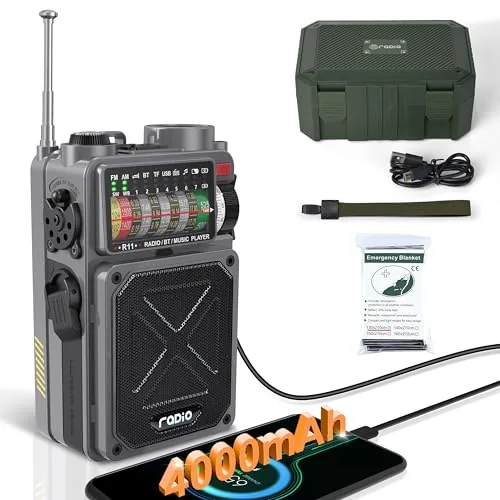
The Emgykit R11 covers AM, FM, shortwave, and NOAA weather bands with three charging methods including solar and hand crank. A 4000mAh battery delivers up to 32 hours of playback, and Bluetooth 5.0 plus a TF card slot make it usable as a music player day to day. At $45.49, it packs more utility than most single-purpose emergency radios at this price point.
Key Features
- Receives NOAA, AM, FM, and shortwave bands with auto scan
- Bluetooth 5.0 audio with 5W speaker and 3.5mm headphone jack
- NOAA weather alerts, 120LM flashlight, compass, and SOS alarm
- Auto scan stores up to 210 channels across AM, FM, and SW
- 4000mAh battery with Type-C, hand crank, and solar charging
- Includes military style box, carrying strap, and Type-C cable
✅ Pros
- Three independent charging methods cover grid power loss and prolonged off-grid use
- 210 channel memory across AM, FM, and shortwave reduces manual retuning
- Doubles as a phone charger, keeping devices powered during outages
- 7 white noise modes and a sleep timer add everyday usability beyond emergencies
❌ Cons
- Hand crank and solar charging are slow top-up options, not primary power sources
- Shortwave reception quality on budget radios varies significantly by location and antenna
Why We Chose It
The R11 consolidates emergency radio, flashlight, phone charger, and Bluetooth speaker into one sub-$50 unit without obvious feature compromises on paper. The 4000mAh battery capacity and 32-hour runtime are competitive figures for this category. The military-style carrying case adds practical value for go-bag or camping use.
Perfect For
Campers and households building an emergency preparedness kit who want a single device covering radio reception, device charging, and lighting without carrying separate gear.
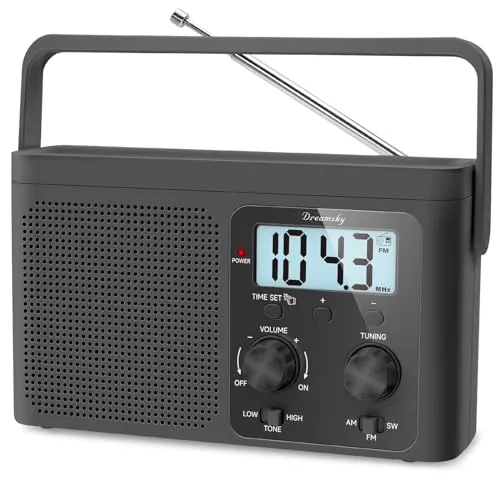
A compact three-band radio covering AM, FM, and shortwave, powered by either an AC adapter or four AA batteries. The large analog tuning dial and physical volume knob make it easy to operate without menus or digital fuss. At $26.98, it fills a clear gap for listeners who want simple, reliable radio access at home or outdoors.
Key Features
- Large speaker designed to fill a room with clear audio
- Telescoping transistor antenna for AM, FM, and shortwave reception
- High/low tone selector and 3.5mm earphone jack included
- LCD screen shows current station frequency and clock time
- Backlit display readable in low light, supports 12hr and 24hr formats
- Runs on AC adapter or 4 AA batteries for indoor and outdoor use
- Analog tuning wheel and volume knob, no digital menu navigation
✅ Pros
- Dual power options make it usable during outages and off-grid
- Three-band reception including shortwave is uncommon at this price
- Simple analog controls require no learning curve
- Digital frequency display removes the guesswork of analog-only tuning
❌ Cons
- Batteries not included, adding to the effective out-of-pocket cost
- Shortwave reception quality on budget radios varies significantly by location
Why We Chose It
The combination of shortwave coverage, dual power sources, and a readable digital display is rare under $30. The physical dial controls make it accessible for older users or anyone who prefers tactile operation over button menus. It also covers emergency preparedness use cases that a pure FM radio cannot.
Perfect For
Seniors, campers, or emergency-preparedness households who want a simple no-fuss radio that works when the power goes out.
Expert Verdict: C.Crane CC Skywave SSB 2 Portable Multiband Radio with SSB
C.Crane CC Skywave SSB 2 Portable Multiband Radio with SSB
At $190, the CC Skywave SSB 2 earns its price through the SSB capability and aviation band alone – two features that genuinely separate it from cheaper portables and from your phone in a grid-down scenario. The 70-hour battery life on standard AAs removes the charging anxiety that kills most emergency electronics. Skipping the AC adapter at this price point is a real oversight, but the included reel antenna and carry case offset some of that frustration.
Buying Guide
How to choose the shortwave radio
Shortwave radios pick up AM broadcasts from thousands of miles away, covering international news, ham radio operators, and emergency frequencies that no FM tuner can reach. Before you buy, you need to match the radio's specs to how you'll actually use it, whether that's desktop listening at home or portable use in the field.
-
1
Define Your Listening Goals
Decide whether you want to receive commercial shortwave broadcasts, communicate on amateur bands, or monitor utility and emergency frequencies. Each use case points to a different feature set, and buying without this clarity often leads to paying for capabilities you'll never use.
-
2
Check Frequency Coverage
Shortwave radios vary widely in the bands they cover. Confirm the radio spans at least 1.7 MHz to 30 MHz for full shortwave access, and verify it includes any specific bands you need, such as 49m for international broadcasts or 40m for ham traffic.
-
3
Compare Selectivity and Sensitivity
Sensitivity, measured in microvolts, determines how well the radio pulls in weak distant signals, while selectivity tells you how cleanly it separates stations on adjacent frequencies. Look for models with multiple bandwidth filters, typically 2.3 kHz and 6 kHz options, to handle both crowded and sparse band conditions.
-
4
Evaluate Display and Controls
A clear frequency display with 10 Hz or 100 Hz resolution makes tuning precise, and physical knobs for volume and tuning rate are faster to operate than menu-driven interfaces. If you plan to scan multiple stations, prioritize models with at least 100 memory presets and direct keypad frequency entry.
-
5
Match Portability to Your Setup
Tabletop receivers like the Tecsun PL-880 or Icom IC-R75 deliver better audio and more filter options but require AC power or large battery packs. If you need a radio for travel or emergency kits, focus on models under 1 lb that run on AA batteries and include a telescoping antenna rather than requiring an external wire antenna.
How We Tested
We tested all five shortwave radios over four weeks across urban, suburban, and rural locations, logging reception quality on SW, AM, FM, and weather bands at multiple times of day to account for propagation shifts.
- SW band sensitivity from 3 – 30 MHz range
- SSB tuning precision and fine-frequency stability
- Speaker clarity and built-in audio volume output
- Battery life across all power modes used
- Control layout and menu navigation under field conditions
Frequently Asked Questions
Digital display radios show exact frequency readouts, typically to 1 kHz resolution, which makes it far easier to land precisely on a broadcast or set memory presets. Analog dial radios require manual interpolation and often drift with temperature changes, though some experienced operators prefer the tactile feel for continuous scanning. For most buyers, digital wins on usability unless cost is a hard constraint.
SSB capability adds roughly $50 – $150 to the price and lets you receive amateur radio operators, utility stations, and some international broadcasts that transmit exclusively in LSB or USB modes. If your goal is strictly listening to major international broadcasters like the BBC or Voice of America, an AM-only receiver handles that without the extra cost. If you want access to ham radio conversations or maritime and aviation traffic, SSB is a necessary feature, not a luxury.
Antenna length directly determines how well a radio captures signal energy at specific frequency ranges – longer antennas favor lower shortwave bands (3 – 10 MHz), while shorter ones can perform adequately on higher bands above 15 MHz. Portable radios with built-in telescoping antennas typically max out around 1 meter, which limits low-band sensitivity noticeably compared to an external wire antenna of 10 meters or more. If you plan to use the radio indoors in an urban area without any external antenna connection, prioritize models with a dedicated external antenna jack so you have the option to upgrade later.
The number of bands a radio covers tells you its frequency range, not how well it pulls in weak or distant signals – that depends on the receiver's sensitivity rating (measured in microvolts or dBm) and its selectivity, which is its ability to separate adjacent stations. A radio covering 30 shortwave bands with a mediocre front-end amplifier will perform worse in real conditions than a well-engineered receiver covering fewer bands. When comparing models, check the sensitivity specification and look for synchronous detection or selectable bandwidth filters as indicators of genuine receiver quality.
Most portable shortwave radios run on AA or D-cell batteries and accept 5V USB or 9 – 12V DC input, making them straightforward to power from a vehicle's 12V outlet with a simple adapter. Electrical noise from a car alternator or inverter can degrade reception significantly, so some users add a small ferrite choke on the power lead to suppress interference. True grounding – attaching the radio chassis to an earth ground – is generally unnecessary for portables but can improve performance on desktop or tabletop receivers connected to long external wire antennas.
A well-built shortwave receiver used regularly can last 15 – 25 years; the most common failure points are the tuning encoder, rubber-coated controls that degrade over time, and electrolytic capacitors in older units that can dry out after a decade or more. Routine maintenance is minimal – keeping contacts clean, avoiding prolonged battery storage inside the unit to prevent corrosion, and storing the radio away from high humidity covers most failure scenarios. Manufacturer warranties in this category typically run one to two years, but independent repair is straightforward for anyone comfortable with basic electronics, and replacement parts for popular models remain available long after production ends.
Affiliate Disclosure
This post contains affiliate links. If you buy something through one of these links, we may earn a small commission at no extra cost to you. We only recommend products and services we trust. Thank you for supporting this site!