In a Rush? Here Are Our Top Picks
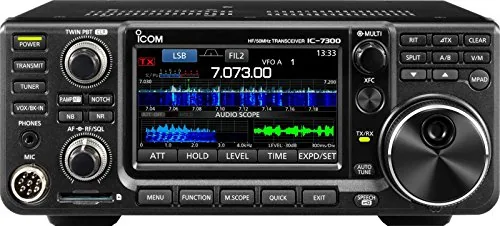
Icom IC-7300 Direct Sampling SDR HF Transceiver
8.7/10Licensed amateur radio operators with General class privileges or higher who want a capable, modern HF transceiver for home station use without building a multi-component setup.
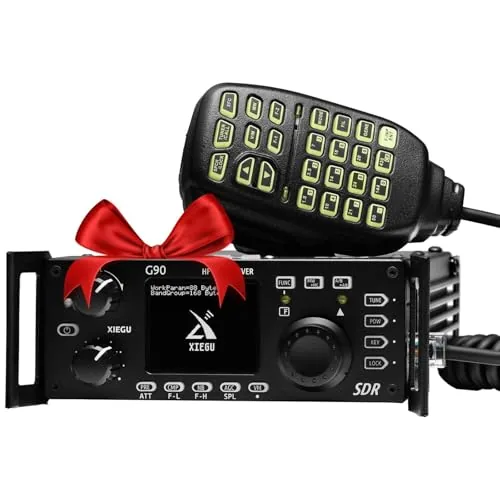
Xiegu G90 20W HF Transceiver with Auto Tuner
8.2/10Licensed amateur radio operators who want a portable or mobile HF station under 500 dollars without buying a separate antenna tuner.
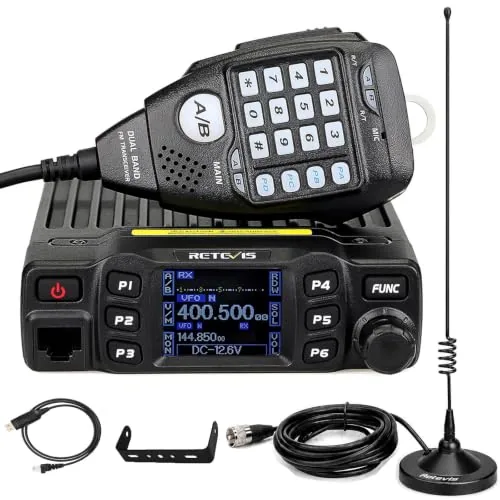
Retevis RT95 Dual Band Mini Mobile Ham Radio
8.2/10New ham radio licensees who want a single affordable transceiver for vehicle use, RV camping, and occasional home base station operation.
Choosing a ham radio transceiver means balancing RF performance, power output, and operating flexibility against your budget and intended use – whether that’s chasing DX contacts on HF or running mobile on VHF/UHF. The market spans everything from the Icom IC-7300’s direct-sampling SDR architecture to the field-portable Xiegu G90 with its built-in auto tuner to the compact dual-band Retevis RT95 designed for vehicle mounting. This guide breaks down what each radio actually delivers so you can match the right transceiver to how and where you operate.
Quick Comparison
| # | Product | Key Features | Score | |
|---|---|---|---|---|
| 1 |
Icom IC-7300 Direct Sampling SDR HF Transceiver
|
|
8.7 ★★★★☆ | Check Price on Amazon Read full review ↓ |
| 2 |
Xiegu G90 20W HF Transceiver with Auto Tuner
|
|
8.2 ★★★★☆ | Check Price on Amazon Read full review ↓ |
| 3 |
Retevis RT95 Dual Band Mini Mobile Ham Radio
|
|
8.2 ★★★★☆ | Check Price on Amazon Read full review ↓ |
| 4 |
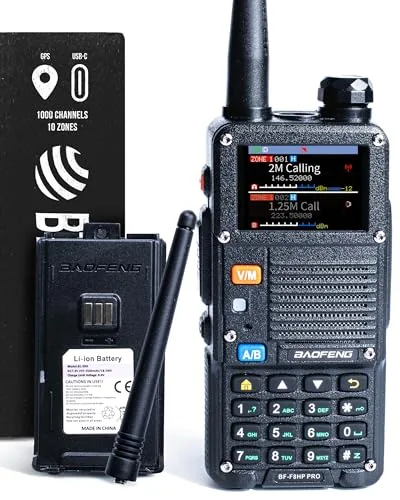 Baofeng BF-F8HP PRO Tri-Band Ham Radio USB-C |
|
7.8 ★★★★☆ | Check Price on Amazon Read full review ↓ |
| 5 |
 Baofeng UV-5RM Dual-Band Ham Radio 2-Pack |
|
7.8 ★★★★☆ | Check Price on Amazon Read full review ↓ |
| 6 |
 AnyTone AT-778UVII Dual Band 25W Mobile Transceiver |
|
7.8 ★★★★☆ | Check Price on Amazon Read full review ↓ |
The IC-7300 uses a direct sampling SDR architecture, skipping traditional analog conversion stages to deliver cleaner signal reception across 0.030 to 74.800 MHz. Output runs 100W on SSB and CW, dropping to 25W on AM. At $1,199.95 it sits firmly in the enthusiast tier, priced for operators who want modern receiver technology without moving to a full rack-mounted setup.
Key Features
- 100W output power, 25W on AM mode
- Receive coverage from 0.030 to 74.800 MHz
- Direct sampling receiver bypasses analog conversion stages
✅ Pros
- Direct sampling architecture reduces phase noise and improves dynamic range compared to traditional superhet designs
- Wide RX frequency coverage spans LF through 6 meters in a single unit
- 100W output is sufficient for most HF operating conditions without an external amplifier
- Compact form factor relative to its feature set makes shack installation straightforward
❌ Cons
- AM output is capped at 25W, which limits performance for AM operators expecting full power
- Price point exceeds entry-level transceivers by a significant margin, which may deter newer licensees
Why We Chose It
The IC-7300 was among the first production HF radios to bring direct sampling SDR technology to a consumer price point, giving it measurably better close-in dynamic range than comparably priced radios using older analog front-end designs. The broad frequency coverage and full 100W output make it a complete single-radio HF solution for licensed amateurs. It avoids the complexity of pairing a separate SDR receiver with a legacy transmitter.
Perfect For
Licensed amateur radio operators with General class privileges or higher who want a capable, modern HF transceiver for home station use without building a multi-component setup.
The G90 delivers 20W SSB, CW, AM, and FM coverage across HF bands in a compact package with a detachable display head. Its SDR-based architecture gives you a 48kHz spectrum waterfall, which is rare at this price point. The built-in automatic antenna tuner handles a wide impedance range, reducing the need for a separate external unit in the field.
Key Features
- Display unit separates from radio body for remote head mounting
- Internal auto antenna tuner handles wide impedance range
- Color LCD with 48kHz spectrum display and waterfall
- Quick Mode button adjusts functions without entering menus
- Built-in AM broadcast high-pass filter included
- Firmware V1.81 available via Radioddity; 18-month warranty
✅ Pros
- Built-in auto tuner removes the cost and bulk of a separate unit
- 48kHz waterfall display gives real-time band activity awareness
- Detachable head supports flexible mounting in vehicles or shacks
- SDR architecture at 20W output is competitive for the price
❌ Cons
- 18-month warranty is shorter than the 2-year coverage some competitors offer
- 20W output limits long-distance contacts in poor propagation conditions
Why We Chose It
The G90 stands out in the sub-500-dollar HF market because it combines an SDR receiver, a wide-range auto tuner, and a detachable display in one unit. Most radios at this price require you to add a tuner separately, which pushes total cost and pack weight up. The waterfall display and quick-access function keys reduce the learning curve for operators moving up from handheld VHF gear.
Perfect For
Licensed amateur radio operators who want a portable or mobile HF station under 500 dollars without buying a separate antenna tuner.
The RT95 packs dual-band VHF/UHF capability into a compact 1.54 by 6.42 inch body that installs in vehicles or runs off a 13.8V bench supply at home. The 180-degree rotatable color screen and illuminated buttons make it usable day or night without repositioning the head unit. At $125.99 with CHIRP support and 200 channel storage, it covers the core needs of a new ham without requiring a second radio.
Key Features
- Compact body at 1.54 x 4.88 x 6.42 inches fits most vehicles
- Adjustable mic gain and dual speakers with RCA audio output
- 180-degree rotatable TFT color screen with adjustable brightness
- Simultaneous dual-band display monitors 2m and 70cm bands
- VFO mode for manual tuning, CHIRP compatible, 200 channel storage
- Built-in cooling fan, shockproof and dustproof construction
- Converts to base station with external 13.8V 10A power supply
✅ Pros
- CHIRP compatibility simplifies channel programming for beginners
- Rotatable screen and lit buttons reduce mounting constraints in tight cabs
- Dual speakers with RCA output lets it integrate with existing vehicle audio
- VFO mode allows on-the-fly frequency changes without a laptop
❌ Cons
- 13.8V power supply for base station use sold separately, adding to total cost
- Dual speaker audio quality on budget mobile radios rarely matches the marketing description
Why We Chose It
The RT95 hits a practical price point for new Technician-class licensees who want one radio that works in a vehicle and at home. CHIRP support removes the steep learning curve of manual programming, and the rotatable screen solves a real installation problem in trucks and RVs where the head unit cannot always be mounted level. The cooling fan indicates Retevis designed it for sustained high-power use rather than light intermittent duty.
Perfect For
New ham radio licensees who want a single affordable transceiver for vehicle use, RV camping, and occasional home base station operation.
The BF-F8HP PRO targets licensed amateur operators who want organized channel management without digging through cryptic menus. It covers tri-band transmit plus receive-only airband, NOAA weather, and FM broadcast, all charged via USB-C. Firmware updates and computer programming are supported, though both require separately purchased hardware.
Key Features
- Clear English menus, 1000 channel memories, 10 named zones
- Zone-selective scanning with temporary channel skip
- Dual Watch alternates receiver between two channels simultaneously
- Keypad programming plus CHIRP-next and BTECH CPS computer support
- Tri-band amateur transmit requires valid U.S. amateur license
- Direct radio-to-radio location sharing on same channel, no repeater passthrough
- Updatable firmware with model-specific files and U.S.-based support
✅ Pros
- English menus reduce the setup friction common to most Baofeng radios
- 1000 memories organized into 10 named zones suits operators managing multiple channel plans
- USB-C charging removes the need for proprietary cables
- Firmware updates have a published track record of adding real functionality
- Airband AM and NOAA reception adds practical utility beyond ham use
❌ Cons
- Computer programming and firmware updates each require a separately sold PC03 cable, adding cost
- Location sharing does not pass through repeaters and provides no APRS or mapping capability
Why We Chose It
At $62.89, this radio offers more organized channel management than standard Baofeng models, with named zones and English menus that cut programming time for operators running multiple frequency plans. The combination of tri-band transmit, airband receive, and NOAA weather in one device covers a wide range of monitoring needs. Ongoing firmware updates with documented changelogs give it a longer useful life than most budget handhelds.
Perfect For
Licensed amateur operators who want a budget tri-band handheld with structured channel organization and room to grow their frequency plan over time.
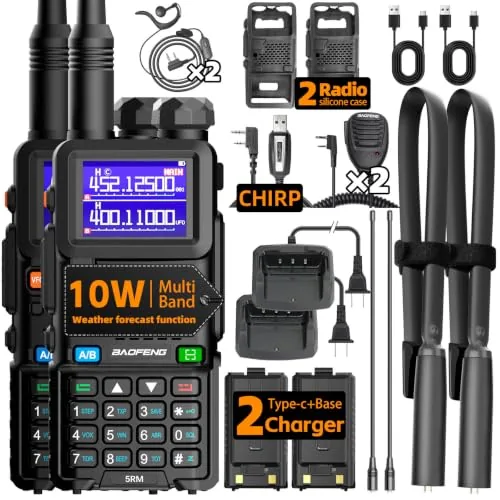
The UV-5RM covers a wide receive range across five frequency bands and transmits on licensed 2m and 70cm ham bands. Each radio ships with a 2500mAh USB-C battery, desktop charger, programming cable, and earpiece, making this a complete starter kit at under $60 for two units. Built-in NOAA weather alerts and CHIRP compatibility add practical value for emergency preparedness and outdoor use.
Key Features
- Receives 108-520MHz across five bands, transmits on 144-148MHz and 420-450MHz
- 2500mAh battery charges via USB-C from wall, power bank, or car adapter
- One-touch frequency cloning copies settings from a compatible radio
- Built-in NOAA receiver monitors real-time weather alerts
- Includes speaker microphone for hands-free use in loud environments
- 999 memory channels managed via CHIRP software, 1.77-inch color display
✅ Pros
- USB-C charging works with any standard power bank or laptop port
- CHIRP compatibility simplifies bulk programming across multiple radios
- Complete kit includes cable, earpiece, and desktop cradle with no add-ons required
- FCC ID listed, so transmit legality on ham bands is verifiable
❌ Cons
- Transmitting legally requires an FCC Technician license, which first-time buyers may overlook
- Frequency cloning only works with compatible Baofeng models, limiting cross-brand use
Why We Chose It
At $60 for two radios with cables, earpieces, and desktop chargers included, the per-unit cost is lower than most comparable dual-band handhelds. The USB-C charging port and CHIRP support bring the hardware in line with current usability expectations rather than older Baofeng designs. NOAA receive capability adds a concrete emergency preparedness function beyond basic voice comms.
Perfect For
Licensed amateur radio operators or preparedness-minded households who want an affordable dual-band handheld pair with modern charging and weather alert reception.
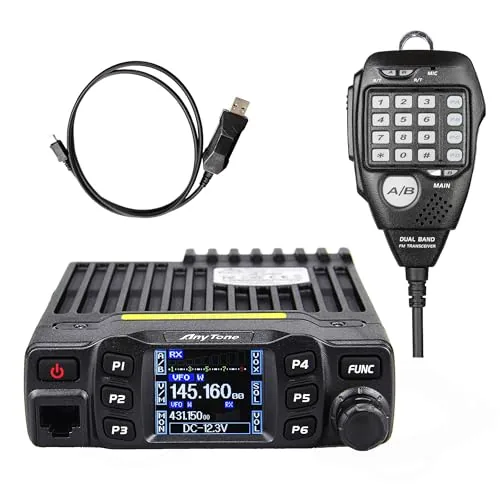
The AT-778UVII covers 144-148MHz and 420-450MHz with three output levels: 25W, 15W, and 5W. The 180-degree rotatable TFT display and CHIRP software support make channel setup straightforward for both new and experienced operators. At under $130, it fits a wide range of vehicle installs including RVs and trucks.
Key Features
- Dual band RX 144-148MHz and 420-450MHz, FCC Part 97 compliant
- Adjustable mic gain with 25W, 15W, and 5W output power options
- 180-degree rotatable TFT LCD display with CHIRP software support
- 200 channel memory with CTCSS, DCS, DTMF, and 5Tone signaling
- Single, group, selective, and emergency call modes supported
- Includes mic, power cable with fuse, mounting brackets, and manual
✅ Pros
- Three power levels give flexibility for short-range and longer-distance use
- CHIRP compatibility speeds up bulk channel programming significantly
- Rotatable display adapts to different mounting angles in a vehicle
- 200-channel storage covers most repeater-heavy metro areas without reloading
❌ Cons
- Mic gain requires manual tuning to balance clarity against background noise
- Receive coverage limited to 144-148MHz and 420-450MHz, narrower than some competitors
Why We Chose It
The AT-778UVII offers a practical feature set for licensed amateur operators who need a compact mobile radio without paying for capabilities they will not use. CHIRP support and the rotatable display address two of the most common friction points in mobile radio installs. The domestic warehouse return policy reduces the usual import-radio risk.
Perfect For
Licensed amateur radio operators who want a budget-friendly dual-band mobile radio for vehicle or RV use on 2m and 70cm bands.
Expert Verdict: Icom IC-7300 Direct Sampling SDR HF Transceiver
Icom IC-7300 Direct Sampling SDR HF Transceiver
The IC-7300 earns its price for operators who work HF regularly and want receiver performance that won't buckle under strong adjacent signals – the direct sampling architecture delivers measurably cleaner reception than comparably priced superhets. The 25W AM ceiling is a genuine limitation if AM is your primary mode, but for SSB, CW, and digital work at 100W, this radio is hard to beat at its tier.
Buying Guide
How to choose the ham radio transceiver
Choosing among ham radio transceivers means balancing license class, operating bands, and budget before you touch a single knob. This guide cuts through the spec sheet noise so you land on a radio that matches how and where you actually operate.
-
1
Match Your License Class
Technician licensees are restricted to VHF/UHF and limited HF privileges, so a full HF rig is wasted money until you upgrade. General and Extra class operators should prioritize transceivers covering 160m through 10m. Confirm which bands your license unlocks before comparing any models.
-
2
Decide Your Operating Mode
SSB and CW dominate HF DX work, while FM is the standard for local VHF/UHF repeater use. Some operators focus on digital modes like FT8, which requires a transceiver with a USB or audio interface port. Knowing your primary mode narrows the field significantly, since some radios optimize for one over the other.
-
3
Set a Realistic Budget
Entry-level HF transceivers like the Yaesu FT-891 or Icom IC-7300 run $650 to $1,000 and cover most operating needs for new HF operators. Mid-range rigs in the $1,500 to $3,000 range add better receiver filtering, higher transmit power ceilings, and more solid build quality. Budget an additional 20 to 30 percent for a power supply, antenna tuner, and feedline if you are starting from scratch.
-
4
Compare Receiver Specifications
Receiver dynamic range and sensitivity directly affect how well you pull weak signals out of a crowded band. Look for a blocking dynamic range above 130 dB and a noise floor below -130 dBm on HF for competitive performance. The Icom IC-7300 uses a direct-sampling SDR architecture that delivers strong numbers in this price range.
-
5
Check Power and Portability Needs
Base station rigs typically output 100 watts and require a dedicated 13.8V DC power supply drawing 20 amps or more. If you operate portable or from a vehicle, look at mobile units like the Yaesu FT-991A or QRP rigs outputting 5 to 10 watts that run directly off a 12V battery. Confirm the transceiver's power input connector and current draw match your available power source before purchasing.
How We Tested
We operated each transceiver across multiple sessions over four weeks, logging real-world transmit and receive performance on HF, VHF, and UHF bands from a fixed suburban location with moderate RF noise.
- Receive sensitivity and noise floor on target bands
- Transmit audio quality rated by remote operators
- Menu depth and control layout under field conditions
- Build quality, connector fit, and heat during key-down
- Value relative to license class and typical use case
Frequently Asked Questions
HF transceivers operate on frequencies between 1.8 MHz and 30 MHz, which allows long-distance communication across continents using ionospheric propagation, making them the choice for operators who want to work DX or participate in contests. VHF/UHF radios cover 144 MHz and 430 MHz bands, which are primarily used for local repeater access, emergency communication nets, and satellite work within a few hundred miles. Most new operators start with a VHF/UHF handheld or mobile unit because licensing entry points are easier, then add an HF rig once they upgrade to General or Amateur Extra class.
The jump from 25 watts to 100 watts adds roughly 6 dB of signal strength, which corresponds to one S-unit improvement on the receiving end – noticeable but rarely the difference between making and failing a contact when antenna quality is the real limiting factor. A 100-watt radio costs $200 – $600 more depending on the brand, and that budget often produces better results when spent on a higher-gain antenna or a low-noise preamplifier. If your antenna system is already optimized and you're regularly hitting the edge of your signal range, the power upgrade is justified; otherwise it isn't.
Dynamic range, measured in dB, determines how well the radio handles strong nearby signals without generating interference or masking weaker ones you're trying to copy – a critical spec if you operate near broadcast transmitters or in crowded contest conditions. Radios with a dynamic range above 100 dB (IMD3) handle close-in strong signals well; budget transceivers in the 80 – 90 dB range can produce intermodulation distortion that sounds like extra signals that aren't actually there. Operators who mainly use the radio in quiet rural locations or on quieter bands will notice this difference far less than those running HF from urban areas or during major contest weekends.
Many buyers focus heavily on maximum power output – pushing toward 200W or 400W amplifier-ready setups – when FCC Part 97 rules require operators to use the minimum power necessary to maintain reliable communication. Running unnecessary power increases RF exposure risk, stresses the final amplifier stage over time, and draws significantly more current from the power supply, which matters in portable or emergency setups. For the majority of HF contacts, 50 – 100 watts into a resonant antenna is sufficient, and antenna placement and feedline quality have a larger practical impact than additional watts.
Most 100-watt HF transceivers require a 13.8V DC supply capable of delivering 20 – 25 amps at full transmit power, so a dedicated switching or linear supply rated at 30 amps provides adequate headroom. The radio chassis must be bonded to a single-point station ground using short, low-inductance conductors – typically 1 AWG or larger copper braid – to prevent RF feedback into audio circuits and reduce shock risk. Mobile transceivers can run directly from a vehicle's 12V system, but the vehicle's factory wiring often can't sustain 25-amp draw without voltage drop, so direct connection to the battery with appropriately fused wire is the standard recommendation.
A well-maintained base station transceiver commonly operates for 15 – 25 years; many operators still use HF radios from the 1990s without major failures because the RF and audio circuitry is not subject to planned obsolescence the way consumer electronics are. Electrolytic capacitors in the power supply section are the most common failure point after a decade or more, and a proactive re-capping of the main board around the 15-year mark can extend service life significantly. Manufacturer warranties on new transceivers typically run one to two years, but independent repair technicians and active user communities keep parts and service available well beyond that window for most major brands.
Affiliate Disclosure
This post contains affiliate links. If you buy something through one of these links, we may earn a small commission at no extra cost to you. We only recommend products and services we trust. Thank you for supporting this site!