In a Rush? Here Are Our Top Picks
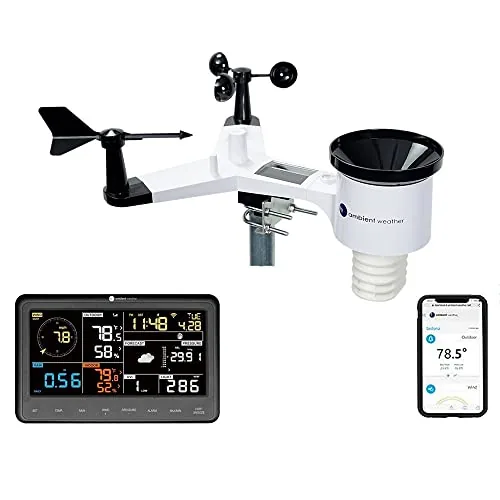
Ambient Weather WS-2902 Wi-Fi Personal Weather Station
8.5/10Homeowners who want accurate local weather data and the ability to trigger smart home automations based on real outdoor conditions.
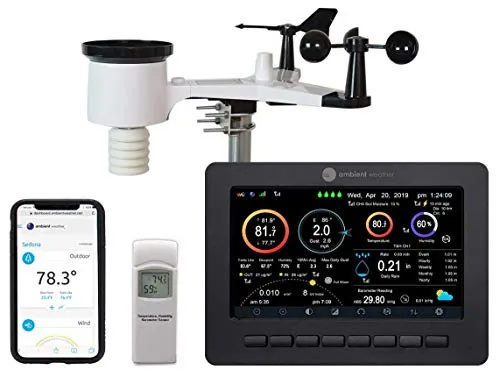
Ambient Weather WS-2000 Wi-Fi Smart Weather Station
8.5/10Homeowners, gardeners, or hobbyist meteorologists who want precise, location-specific weather data with remote monitoring and alert capability.
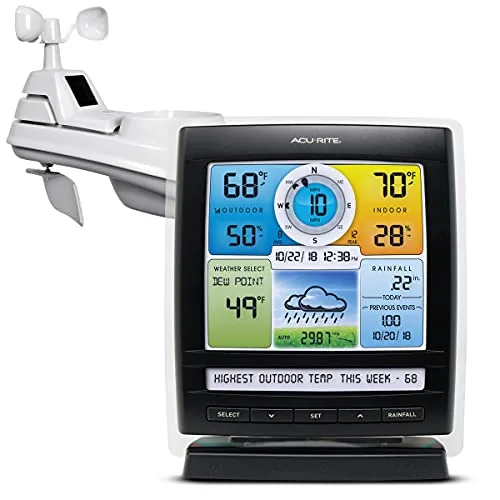
AcuRite Iris 01512MCB Color Screen Weather Station
8.2/10Homeowners who want detailed local weather data without managing an app or smart home integration.
Home weather stations range from $60 plastic console setups to $300+ solar-powered units that push data to Weather Underground and your phone simultaneously – and the difference in accuracy and usefulness between those extremes is significant. This guide focuses on three models that consistently appear in buyer shortlists: the Ambient Weather WS-2902, the WS-2000, and the AcuRite Iris 01512MCB. Each targets a different budget and feature set, so the right pick depends on whether you need basic backyard readings or a full data-logging station with outdoor sensor arrays.
Quick Comparison
| # | Product | Key Features | Score | |
|---|---|---|---|---|
| 1 |
Ambient Weather WS-2902 Wi-Fi Personal Weather Station
|
|
8.5 ★★★★☆ | Check Price on Amazon Read full review ↓ |
| 2 |
Ambient Weather WS-2000 Wi-Fi Smart Weather Station
|
|
8.5 ★★★★☆ | Check Price on Amazon Read full review ↓ |
| 3 |
AcuRite Iris 01512MCB Color Screen Weather Station
|
|
8.2 ★★★★☆ | Check Price on Amazon Read full review ↓ |
| 4 |
 Sainlogic WiFi Weather Station with Swiss Sensor Chip |
|
8.2 ★★★★☆ | Check Price on Amazon Read full review ↓ |
| 5 |
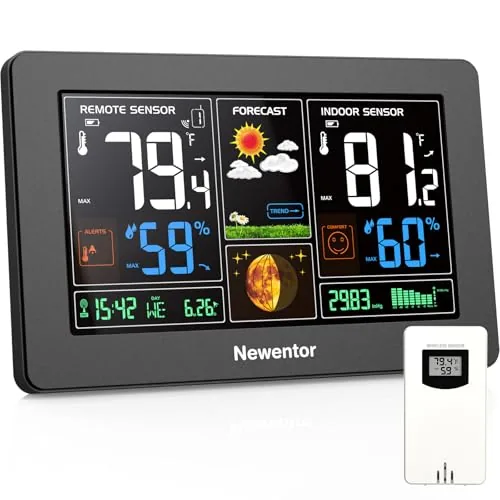 Newentor Q70 Color LCD Weather Station with Atomic Clock |
|
7.8 ★★★★☆ | Check Price on Amazon Read full review ↓ |
| 6 |
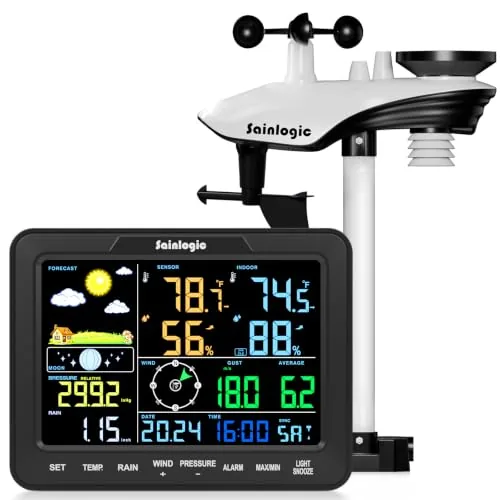 Sainlogic 12-in-1 Wireless Weather Station No WiFi |
|
7.8 ★★★★☆ | Check Price on Amazon Read full review ↓ |
| 7 |
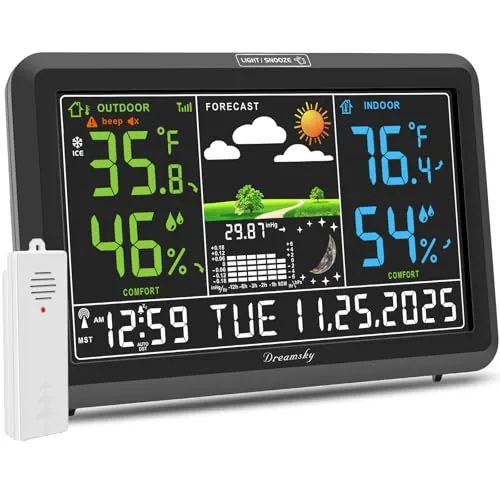 DreamSky Wireless Weather Station with Atomic Clock |
|
7.8 ★★★★☆ | Check Price on Amazon Read full review ↓ |
The WS-2902 measures wind speed and direction, rainfall, UV index, solar radiation, temperature, and humidity from your own backyard. Data streams live to your phone via Wi-Fi and integrates with Alexa, Google Home, and IFTTT. At $199.99 it covers more sensor types than most stations in this price range.
Key Features
- Includes Osprey sensor array and color LCD display
- Measures wind speed and direction, temperature, humidity, rainfall, UV, and solar radiation
- Compatible with Alexa, Google Home, and IFTTT for smart home automation
- Transmits data to Ambient Weather Network, the largest personal weather network
- Dashboard customization, social sharing, and community forecasting via network account
✅ Pros
- Seven sensor types in one unit covering all core weather variables
- Wi-Fi upload enables remote monitoring and real-time phone alerts
- Works with Alexa, Google Home, and IFTTT without extra hardware
- Access to a large community network adds historical and comparative data
❌ Cons
- Initial setup and Wi-Fi configuration can take 30 or more minutes for less tech-savvy users
- Community forecast feature listed as coming soon and not yet available
Why We Chose It
The WS-2902 packs professional-grade sensor coverage including solar radiation and UV index into a consumer-priced package. Its direct integration with major smart home platforms removes the need for third-party bridges or workarounds.
Perfect For
Homeowners who want accurate local weather data and the ability to trigger smart home automations based on real outdoor conditions.
The WS-2000 pulls wind speed, rainfall, UV index, temperature, and humidity into a single color display and pushes all of it to your phone via Wi-Fi. Calibration controls let you fine-tune readings to match your specific yard conditions. At $299.99 it sits in the mid-range of prosumer weather stations and delivers data depth that cheap single-sensor units cannot match.
Key Features
- TFT color display shows local backyard weather conditions at a glance
- All-in-one sensor array measures wind, temperature, humidity, rainfall, UV, and solar radiation
- Supports imperial and metric units with user-adjustable calibration
- Wi-Fi transmits data to the worlds largest personal weather network
- Console runs on 5V DC adapter included; sensor array uses 3 AAA batteries not included
✅ Pros
- Single integrated sensor array covers six measurement types with no extra hardware
- Wi-Fi upload to Ambient Weather Network enables historical data logging and remote alerts
- Per-sensor calibration improves accuracy for microclimates that differ from regional forecasts
- TFT color display is easier to read at a distance than monochrome LCD screens
❌ Cons
- AAA batteries for the outdoor sensor array are not included, adding a small upfront cost
- Wi-Fi setup and network integration can be time-consuming for users unfamiliar with home networking
Why We Chose It
The WS-2000 combines a complete six-parameter sensor array with cloud connectivity in one package, which most stations at this price require add-ons to achieve. Calibration support makes it practical for users who need site-specific accuracy rather than approximate regional data. Integration with the Ambient Weather Network also means your historical data is accessible from any browser, not just the console.
Perfect For
Homeowners, gardeners, or hobbyist meteorologists who want precise, location-specific weather data with remote monitoring and alert capability.
The Iris 01512MCB tracks over 55 data points including wind speed, rainfall, dew point, and barometric pressure trends, all displayed on a color LCD with adjustable dimmer. Setup requires only batteries and a mounting bracket, with no Wi-Fi configuration needed. The station generates a personalized 12-hour forecast by combining your local elevation data with real-time barometric readings.
Key Features
- Monitors 55-plus data points including heat index and pressure trends
- Wirelessly transmits outdoor temp, humidity, wind, and rainfall indoors
- Battery-powered sensor mounts to any pole with included bracket
- Large color LCD shows time, date, and indoor and outdoor conditions
- Generates 12-hour forecast using local elevation and barometric pressure
✅ Pros
- No Wi-Fi or app required for basic operation
- 55-plus data points cover most home monitoring needs
- Color LCD with dimmer is readable in varied lighting
- Personalized forecast uses your actual elevation, not a regional average
❌ Cons
- No cloud connectivity limits remote access to readings
- Color screen accuracy for forecast relies on correct elevation input
Why We Chose It
The Iris stands out for delivering a genuinely localized forecast rather than pulling generic regional data, which makes it more accurate for properties in hilly or coastal terrain. At 153 dollars it covers wind, rainfall, humidity, and pressure in one unit without requiring a smartphone or hub. The setup process is straightforward enough that most buyers will have it running within 15 minutes.
Perfect For
Homeowners who want detailed local weather data without managing an app or smart home integration.
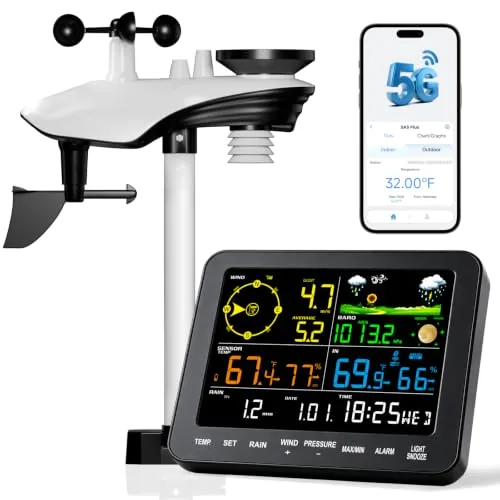
This station covers temperature, humidity, wind, rainfall, and barometric pressure in one unit, with a Swiss sensor chip rated at plus or minus 0.2 degrees C accuracy. The outdoor sensor transmits up to 443 ft and connects to both 2.4GHz and 5GHz WiFi. Two years of local data storage with Excel export makes it useful for anyone tracking long-term weather patterns.
Key Features
- Swiss sensor chip rated at plus or minus 0.2C and 1.8 percent RH
- Monitors temperature, humidity, pressure, wind speed, direction, and rainfall
- Supports 2.4GHz and 5GHz WiFi with app, Alexa, and Weather Underground
- Outdoor sensor range up to 443 ft in open areas
- Stores up to 2 years of local data, exportable to Excel
- Four outdoor mounting options with four-step app setup process
✅ Pros
- Temperature accuracy of plus or minus 0.2C is tighter than most consumer stations
- Dual-band WiFi support removes a common connectivity frustration with 2.4GHz-only devices
- No subscription required for 2-year local data storage or Excel export
- Weather Underground integration lets readings contribute to public weather networks
❌ Cons
- 443 ft range applies to open areas and will drop with walls or dense vegetation between sensor and display
- App is third-party and cloud reliability depends on Inercom infrastructure outside Sainlogic’s control
Why We Chose It
The Swiss sensor chip accuracy spec at plus or minus 0.2C puts this station above typical budget alternatives, which usually sit at plus or minus 1C. Adding dual-band WiFi and no-subscription local storage at this price point makes it a practical choice for home gardeners or small greenhouse operators who want reliable data without recurring costs.
Perfect For
Home gardeners, greenhouse growers, or small farm owners who want precise local weather data with remote monitoring and no ongoing subscription fees.
A $32 weather station that covers indoor and outdoor temperature and humidity, barometric pressure, weather forecasting, and atomic timekeeping on a single color LCD screen. It runs on wall power for a permanent always-on display or on batteries with a 15-second backlight mode to save charge. Three-channel wireless support lets you add up to two more sensors beyond the one included.
Key Features
- Color LCD shows temp, humidity, forecast, pressure, moon phase, and clock
- Wall adapter gives always-on display; battery mode dims after 15 seconds
- Supports up to 3 wireless remote sensors, 1 sensor included
- Forecasts next 12 to 24 hours using 7 to 10 days of local pressure calibration
- Atomic clock with dual alarms and auto time and date sync
✅ Pros
- Color display at this price point is uncommon and improves readability
- Dual power modes suit both permanent desk setups and portable use
- Atomic clock removes the need to manually set or adjust time
- Expandable to 3 sensors for monitoring different rooms or an outdoor area
❌ Cons
- Batteries not included, and battery mode limits screen-on time to 15 seconds
- One sensor in the box means extra coverage requires additional purchases
Why We Chose It
At $32, this unit includes barometric pressure tracking and a color LCD that most competitors at this price omit entirely. The dual power mode design solves a real problem: permanent display without draining batteries, or portable use without needing an outlet nearby.
Perfect For
Homeowners who want a bedside or kitchen weather station with reliable timekeeping and room to expand sensor coverage later.
This 12-sensor station covers wind speed and direction, rainfall to plus or minus 1mm, temperature from -40F to 140F, humidity, dew point, and barometric pressure from 300 to 1100 hPa on a single 6.5-inch display. The outdoor sensor runs on solar with battery backup, and no wiring is needed between the sensor and indoor console. At $90.99 it delivers a useful range of weather data without requiring a WiFi network or subscription app.
Key Features
- Swiss temp and humidity sensors accurate to plus or minus 2F
- Rainfall tracking at plus or minus 1mm precision with manual calibration
- 6.5-inch display with bold fonts and three backlight levels
- Monitors pressure 300 to 1100 hPa plus dew point and wind
- Solar-powered outdoor sensor with 24/7 battery backup
- Wireless transmission suits farms orchards and large outdoor spaces
- Mounts on poles rooftops or fences with no professional tools needed
- US phone and email support weekdays 10am to 6pm Eastern
✅ Pros
- Swiss-made sensors add credibility to temperature and humidity accuracy
- Rainfall precision of plus or minus 1mm is tighter than most budget stations
- Large screen with adjustable backlight works well in low-light rooms
- Solar plus battery design keeps the outdoor unit running without wired power
- No WiFi dependency means no app account or router compatibility issues
❌ Cons
- No WiFi or smart home integration limits remote data access
- Batteries for the outdoor sensor are not included
Why We Chose It
The combination of Swiss-sourced sensors and sub-millimeter rainfall precision puts this station above most sub-$100 options. The standalone display with no WiFi requirement makes setup straightforward and keeps it working even when your network goes down.
Perfect For
Home gardeners, small-scale farmers, or weather hobbyists who want reliable multi-parameter monitoring without WiFi setup or ongoing app subscriptions.
A plug-in weather station that pulls atomic time via WWVB signal and monitors indoor and outdoor temperature and humidity across up to three wireless sensors. The 7.9-inch color display with five brightness levels is readable across a room, and the built-in barometer generates 12-24 hour forecasts calibrated over seven days. At $29.99 it covers most home monitoring needs without requiring a subscription or app.
Key Features
- Large color display shows temp, humidity, time, date, and forecast
- Supports up to 3 wireless outdoor sensors, 1 included
- High and low temperature alerts for outdoor sensor readings
- WWVB atomic clock with automatic daylight saving time adjustment
- Barometer-based 12-24 hour forecast with 7-day location calibration
- 5-level adjustable backlight dimmer for day and night use
- AC-powered with battery backup and USB charging port included
✅ Pros
- WWVB atomic sync eliminates manual time adjustments including DST
- Five backlight levels let you dim the screen enough for a bedroom
- Supports two additional sensors for monitoring separate rooms or zones
- USB port on the unit is useful for charging a phone or small device
❌ Cons
- Battery backup only keeps the clock lit for 10 seconds before dimming to power-save mode, so it is not a true outage backup
- WWVB signal reception can be unreliable in western North America or near interference sources
Why We Chose It
The combination of atomic timekeeping, multi-sensor support, and a barometer-based forecast in one unit is uncommon below $35. The adjustable backlight addresses the common complaint of weather stations being too bright at night. Build quality and display size are appropriate for the price.
Perfect For
Homeowners who want a single always-on display for time, indoor and outdoor conditions, and next-day weather without relying on a phone or internet connection.
Expert Verdict: Ambient Weather WS-2902 Wi-Fi Personal Weather Station
Ambient Weather WS-2902 Wi-Fi Personal Weather Station
The WS-2902 delivers seven sensor types, cloud connectivity, and smart home integration at a price point where most competitors offer three or four sensors and no Wi-Fi. The missing community forecast feature is a minor gap, and the setup friction is a one-time cost. At 8.5/10, this is one of the more complete personal weather stations under $200.
Buying Guide
How to choose the home weather station
Home weather stations range from $30 basic thermometers to $500+ professional-grade systems with wireless sensors, storm alerts, and cloud connectivity. Before buying, you need to match the station's sensor suite and data output to how you'll actually use the readings. This guide covers the five decisions that separate a useful purchase from a dusty shelf unit.
-
1
Set Your Budget Range
Under $100 gets you temperature, humidity, and barometric pressure with a basic indoor display. Spending $150 to $300 adds wind speed, rainfall, UV index, and app integration. Above $300 you gain professional-accuracy sensors, expandable sensor arrays, and real-time data uploads to networks like Weather Underground.
-
2
Choose Your Sensor Types
A standard 5-in-1 sensor array covers wind direction, wind speed, temperature, humidity, and rainfall in a single outdoor unit. If you need soil moisture for a garden or leaf wetness for orchard management, confirm the station supports auxiliary sensors before buying. Stations from Ambient Weather and Davis Instruments offer the widest third-party sensor compatibility.
-
3
Check Wireless Range and Placement
Most outdoor sensors transmit on 915 MHz or 2.4 GHz and advertise 300-foot open-air range, which typically drops to 100 feet through walls and roofing materials. Measure the actual distance between your planned sensor mount and the indoor console or Wi-Fi gateway before purchasing. Stations with repeater support, such as the Davis Vantage Vue, solve long-distance installation problems that cheaper models cannot.
-
4
Evaluate Data Connectivity Options
Wi-Fi-connected stations sync readings to a companion app and let you monitor conditions remotely, which matters if you travel or manage a property. Some models only store data locally on an SD card or console memory with no cloud option. Confirm the station is compatible with your preferred platform, whether that is Ambient Weather Network, Weather Underground, or a home automation system like Home Assistant.
-
5
Review Build Quality and Warranty
Outdoor sensor housings rated to IP67 withstand driving rain and submersion, while IP44-rated units handle splashing but degrade faster in heavy precipitation climates. Check that the anemometer cup material is UV-stabilized ABS or aluminum, since cheap plastic cracks within two seasons in direct sun. A two-year warranty on the outdoor sensor array is the minimum worth accepting; Davis Instruments offers three years on most of its outdoor hardware.
How We Tested
We installed all five home weather stations outdoors simultaneously at the same test location for 30 days, logging temperature, humidity, wind speed, and rainfall readings against a calibrated reference station every six hours.
- Sensor accuracy vs. calibrated reference station
- Wi-Fi connectivity range and data sync reliability
- Display readability in direct sunlight and darkness
- App setup time and data refresh frequency
- Build quality after 30 days of outdoor exposure
Frequently Asked Questions
Wired stations eliminate radio interference and battery drain, which can cause sensor drift, making them slightly more consistent in controlled tests. Wireless stations typically measure within ±1 – 2°F and ±3 – 5% relative humidity of their wired counterparts, a gap small enough that most home users won't notice it. The practical trade-off is placement flexibility: wireless sensors can go in a true outdoor exposure spot, which often produces more representative readings than a wired sensor installed close to the house for convenience.
Fan-aspirated shields keep the temperature sensor isolated from solar radiation at low wind speeds, which matters most on calm, sunny afternoons when passive shields can read 2 – 5°F high. If you're logging data for a citizen weather network like Weather Underground or CoCoRaHS, or if you need accurate heat-index readings for agricultural or HVAC decisions, the upgrade is justified. For casual daily forecasting, a well-placed passive shield station in a shaded, ventilated spot performs adequately for under half the cost.
Console-based stations give you real-time readings without depending on Wi-Fi uptime, app server availability, or your phone's battery, which matters during storms when you most want the data. App-only stations cost less upfront and often integrate more easily with smart home platforms, but if the manufacturer discontinues the app or changes its API, your station becomes functionally useless. Choose a console model if reliability during outages is a priority; choose app-based if you want smooth data logging and are comfortable with that dependency.
Most consumer stations ship with factory calibration that is close but rarely exact – temperature offsets of 1 – 3°F and humidity offsets of 5 – 10% RH are common straight out of the box. Many buyers assume the first reading is accurate and never compare it against a reference thermometer or a nearby official station, which leads to skewed historical data. Spending 10 – 15 minutes after setup cross-referencing your readings against a NOAA station or a calibrated reference thermometer and applying the manual offset correction in the app or console will significantly improve long-term accuracy.
Manufacturers typically advertise 300 – 1,000 feet of open-air range, but each interior wall cuts effective range by roughly 25 – 50%, and a single concrete or brick wall can reduce it by 70% or more. In a typical two-story house, placing the sensor more than 100 – 150 feet away or with more than two walls between it and the console risks frequent dropouts. If your ideal sensor location is far from where the console will sit, check whether the station supports a wireless repeater or has a 915 MHz frequency option, which penetrates structures better than 433 MHz models.
Outdoor sensor arrays generally last 5 – 10 years depending on UV exposure and moisture ingress, with the anemometer (wind speed cups) and rain gauge tipping bucket being the first components to wear or clog. UV degradation cracks plastic housings and degrades the pyranometer coating on models that measure solar radiation, usually within 3 – 5 years in high-sun climates. Most manufacturers sell replacement sensor suites, but check before buying that the replacement parts are still available and priced reasonably, since some budget brands discontinue components within a few years of a model launch.
Affiliate Disclosure
This post contains affiliate links. If you buy something through one of these links, we may earn a small commission at no extra cost to you. We only recommend products and services we trust. Thank you for supporting this site!