In a Rush? Here Are Our Top Picks
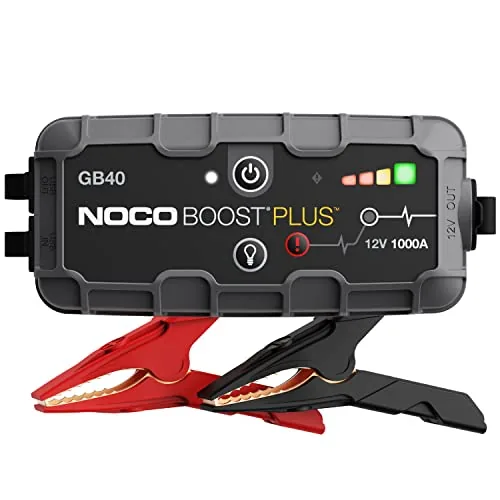
NOCO GB40 1000A Lithium Jump Starter IP65
8.7/10Drivers of gas-powered cars, SUVs, and motorcycles who want a compact, self-contained emergency kit that lives in the vehicle year-round.
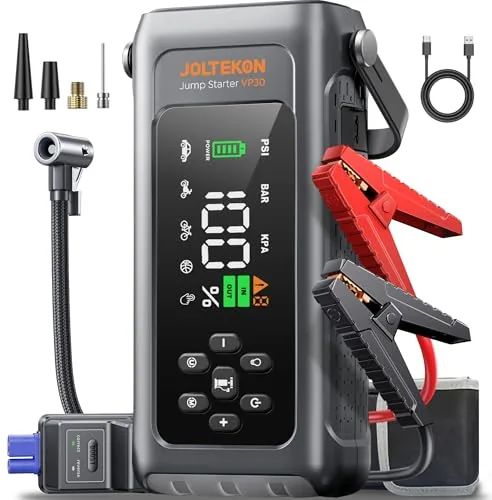
Joltekon 4500A Jump Starter with 150PSI Air Compressor
8.2/10Drivers who want a single emergency kit covering dead batteries, flat tires, and low-light roadside repairs without carrying multiple devices.
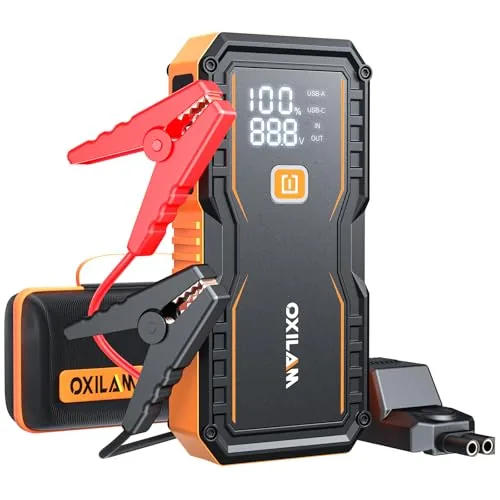
OXILAM 6000A Jump Starter with USB and LED Display
8.2/10Drivers of trucks, RVs, or diesel vehicles who want one compact device that covers jumping, emergency lighting, and device charging without spending over $60.
Portable jump starters have replaced the jumper cable and a kind stranger as the go-to dead-battery fix – you get a self-contained unit in your glove box that works at 2 a.m. in an empty parking lot without another car in sight. The market has matured enough that options now range from compact 1000A lithium packs like the NOCO GB40 to high-output units like the OXILAM 6000A and the Joltekon 4500A, which adds a 150PSI air compressor for tire inflation. Picking the right one comes down to your vehicle’s engine size, how much you’ll actually use the extra features, and whether you want something pocket-sized or a fuller roadside kit.
Quick Comparison
| # | Product | Key Features | Score | |
|---|---|---|---|---|
| 1 |
NOCO GB40 1000A Lithium Jump Starter IP65
|
|
8.7 ★★★★☆ | Check Price on Amazon Read full review ↓ |
| 2 |
Joltekon 4500A Jump Starter with 150PSI Air Compressor
|
|
8.2 ★★★★☆ | Check Price on Amazon Read full review ↓ |
| 3 |
OXILAM 6000A Jump Starter with USB and LED Display
|
|
8.2 ★★★★☆ | Check Price on Amazon Read full review ↓ |
| 4 |
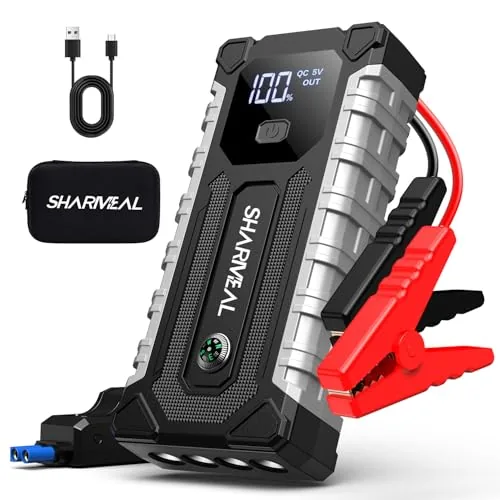 Sharmeal 7000A Jump Starter with Forced Start Button |
|
7.8 ★★★★☆ | Check Price on Amazon Read full review ↓ |
| 5 |
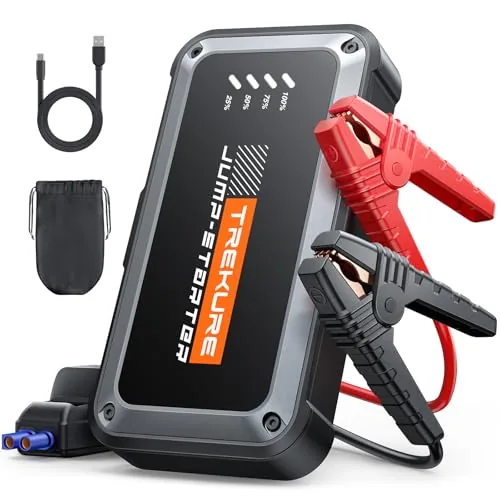 TREKURE 4000A Jump Starter 16800mAh Compact Power Bank |
|
7.8 ★★★★☆ | Check Price on Amazon Read full review ↓ |
| 6 |
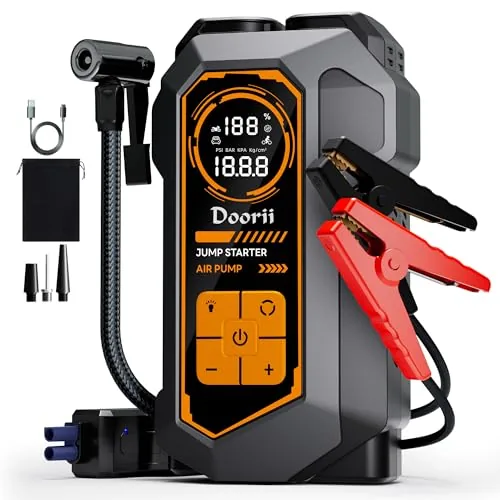 Doorii 6000A Jump Starter with 150PSI Air Compressor |
|
7.8 ★★★★☆ | Check Price on Amazon Read full review ↓ |
| 7 |
 Scatach 3000A Jump Starter for 9.0L Gas/7.0L Diesel |
|
7.2 ★★★★☆ | Check Price on Amazon Read full review ↓ |
The GB40 delivers 1000 peak amps from a 2.5 lb unit, enough to start engines up to 6.0L gas or 3.0L diesel up to 20 times per charge. Spark-proof circuitry and reverse polarity protection make it safe to use without prior experience. The built-in USB power bank and 100-lumen flashlight add genuine roadside utility beyond just jump starting.
Key Features
- 1000A peak power starts engines up to 6.0L gas
- Spark-proof and reverse polarity protection for safe connections
- USB power bank recharges phones and tablets in emergencies
- 100-lumen LED flashlight with 7 modes including SOS and strobe
- Weighs 2.5 lb with IP65 water and dust resistance
- Up to 20 jump starts per full charge
- Recharges fully in approximately 3 hours via USB-C
- Includes heavy-duty clamps, USB-C cable, and storage bag
✅ Pros
- IP65 rating handles rain and dusty engine bays without issue
- Reverse polarity protection removes risk of damage from incorrect clamp placement
- 2.5 lb weight and compact size fit in a glove box
- USB-C charging means no proprietary cable to track down
- 20 starts per charge is practical for multiple vehicles or repeated attempts
❌ Cons
- 3.0L diesel ceiling excludes larger diesel trucks and work vehicles
- One-year warranty is shorter than some competitors at this price point
Why We Chose It
The GB40 combines a realistic peak amp rating with safety features that make it usable by anyone, not just people comfortable around car electronics. IP65 protection and a rubberized housing mean it survives the conditions where you actually need a jump starter. The USB-C charging and power bank features extend its value beyond a single-use emergency tool.
Perfect For
Drivers of gas-powered cars, SUVs, and motorcycles who want a compact, self-contained emergency kit that lives in the vehicle year-round.
A single unit handles dead batteries and flat tires, covering gas engines up to 9L and diesel up to 8L. The built-in 150PSI compressor reaches 25PSI in minutes with auto-shutoff to prevent overinflation. USB-C power bank output and a 500-lumen light panel round out the roadside toolkit.
Key Features
- 8-in-1 unit: jump starter, pump, power bank, four light modes
- 4500A peak current with Force Start for fully dead batteries
- Works from -20C to 60C on gas up to 9L and diesel up to 8L
- 150PSI compressor with 5 inflation modes and automatic shutoff
- 19-cylinder motor inflates tires to 25PSI in minutes
- 4 nozzle types, 3 pressure units, detachable extended hose
- 500-lumen wide-beam light with SOS, strobe, and warning modes
- USB-C output charges phones and tablets with 90-percent efficiency
- 3.3-inch display shows real battery level, readable in sunlight
- 10 safety protections and V0-rated fireproof battery cells
- Supports 1000-plus recharge cycles, 24-month standby capability
- Recharge unit every 2 to 3 months during extended storage
✅ Pros
- Combines jump starter and tire inflator in one compact unit, reducing what you carry
- 4500A output with Force Start handles completely drained batteries, not just weak ones
- Auto-shutoff inflation prevents overinflation without manual monitoring
- 500-lumen light with SOS and red strobe is genuinely useful at roadside scenes
- V0 fireproof rating and 10 protection circuits address the main safety concerns with clamp-based starters
❌ Cons
- Requires 50-percent charge minimum before jumping, so periodic recharging every 2 to 3 months is mandatory
- No independent test data provided to verify the 4500A peak rating against real-world diesel loads
Why We Chose It
At 99.99 dollars, this unit replaces a separate jump pack, tire inflator, and emergency light, which typically costs more bought individually. The auto-shutoff compressor and Force Start mode reduce user error in high-stress situations. V0 fireproof cells and a hardened shell justify keeping it in a vehicle long-term.
Perfect For
Drivers who want a single emergency kit covering dead batteries, flat tires, and low-light roadside repairs without carrying multiple devices.
A 6000A peak-current jump starter that handles gas engines of any size and diesels up to 12L. It doubles as a USB power bank with two output ports and a Type-C input, plus an 800-lumen LED flashlight with strobe and SOS modes. At under $60, it covers a wide range of vehicles from motorcycles to RVs.
Key Features
- 6000A peak current starts all gas and 12L diesel engines
- 10 built-in protections against reverse polarity, sparks, and short circuits
- USB-A and Type-C ports charge phones and tablets up to 75% faster
- 800-lumen LED flashlight with strobe and SOS emergency modes
- LED screen shows real-time battery status and remaining charge level
- Requires charge above 50% before use; recharge every 3 months if stored
✅ Pros
- 6000A rating covers an unusually wide engine range including 12L diesel
- Dual USB-A plus Type-C output makes it a functional roadside power bank
- 10 safety protections reduce risk from user error like reversed clamps
- Compact and lightweight enough to store in a glove box or bag
- LED display removes guesswork about available charge before a jump attempt
❌ Cons
- Unit must be above 50% charge to jump start, requiring proactive maintenance
- No stated battery capacity in mAh makes power bank output hard to benchmark
Why We Chose It
The 12L diesel ceiling sets this apart from most sub-$60 jump starters, which typically cap at 6L or 8L diesel. The integrated Type-C port and multi-mode LED light add practical value beyond jumping, reducing the number of separate tools you need in the car. The 10-protection clamp system lowers the risk of damage from incorrect connection, which matters for users who rarely jump a car.
Perfect For
Drivers of trucks, RVs, or diesel vehicles who want one compact device that covers jumping, emergency lighting, and device charging without spending over $60.
At under $35, this 0.99 lb jump starter delivers 7000A peak current and fits in a glove box. The forced start button lets it revive completely dead batteries that smart cables alone would reject. Metal clamps and 14 built-in protections make it usable without prior experience.
Key Features
- 7000A peak current covers all gas and 12.0L diesel engines
- Forced start button overrides smart cable for fully drained batteries
- Heavy-duty metal clamps with 14 safety protections built in
- Measures 7.8×3.4×1.5 inches and weighs 0.99 lbs
- Includes USB power bank port and 3-mode LED flashlight
- Comes with carrying case, smart cables, and 24-month warranty
✅ Pros
- Forced start override handles batteries too dead for standard smart clamp detection
- Metal clamps instead of plastic reduce failure risk at the connection point
- Sub-1 lb weight and compact size fit a glove compartment without bulk
- USB charging output adds utility between jump-start uses
- 24-month warranty is above average for budget jump starters
❌ Cons
- 7000A peak claim is unverified by third-party testing at this price point
- No onboard battery level display mentioned, making charge status harder to check
Why We Chose It
The forced start button is a concrete functional advantage over jump starters that fail when a battery reads zero voltage to the smart cable. Metal clamps and 14 protection modes address the two most common failure points in cheap jump starters. For the price, the feature set is difficult to match.
Perfect For
Drivers who want a glove-box emergency starter for older or high-mileage vehicles prone to dead batteries.
At under a pound and roughly $36, this jump starter handles engines up to 8.0L gas and 6.5L diesel in sub-zero temperatures. The 16800mAh battery doubles as a USB power bank for phones and tablets. Four-mode lighting adds genuine roadside utility beyond just jumping a dead battery.
Key Features
- 4000A peak current starts 8.0L gas and 6.5L diesel engines
- Operates in temperatures from -4F to 140F
- Rated for 1000 or more jump start cycles
- 16800mAh capacity charges phones and USB devices
- Four lighting modes including SOS and orange strobe
- Dual-angle light design for wider coverage area
- Waterproof, dustproof, and shock-resistant outer shell
- Ten onboard protections including short circuit and overcharge
- Smart chip monitors and prevents reverse current connections
- Weighs 0.8 lbs and approved for carry-on air travel
✅ Pros
- 0.8 lb weight and pocket size make it easy to store in a glove box
- Covers both gas and diesel engines including larger 8.0L displacements
- USB power bank function adds everyday value between emergencies
- Four-mode light with SOS and orange strobe is genuinely useful roadside
❌ Cons
- Must maintain 50 percent charge before use and needs recharging every 3 months in storage, requiring regular maintenance
- 4000A peak rating on a 0.8 lb unit warrants realistic expectations on repeated cold-weather starts
Why We Chose It
For $36, this covers a wide engine range and packs in legitimate secondary features like USB charging and multi-mode lighting rather than just jump starting. The compact form factor and airline approval make it practical for both daily drivers and travelers. Build quality protections and temperature range give it more real-world credibility than most budget units at this price.
Perfect For
Drivers who want a lightweight, dual-purpose jump starter and power bank that fits in a glovebox without taking up meaningful space.
This unit combines a 6000A jump starter and 150PSI tire inflator in a package that fits in a glove box. It handles engines up to 10.0L gas or 8.0L diesel, and the built-in power bank and 400-lumen flashlight add genuine roadside utility. At under $55, it covers more failure scenarios than most single-purpose jump starters twice its price.
Key Features
- Combines jump starter, air compressor, flashlight, power bank, and SOS light
- 6000A peak current starts 12V engines up to 10.0L gas or 8.0L diesel
- 150PSI compressor inflates a car tire from 0 to 20 PSI in roughly 2 minutes
- LCD display shows real-time tire pressure with plus or minus 1 PSI accuracy and auto shutoff
- Power bank charges phones and USB devices via built-in port
- 400-lumen LED flashlight runs up to 48 hours across flashlight, SOS, and strobe modes
- Smart cables include spark-proof, reverse polarity, over-voltage, and short circuit protection
- 1-year replacement warranty and lifetime technical support included
✅ Pros
- Single device replaces jump starter, tire inflator, flashlight, and power bank
- Auto shutoff on the inflator prevents accidental over-inflation
- Smart cable protections make it usable by drivers with no electrical experience
- Rated for operation between -4F and 140F, covering most real-world conditions
❌ Cons
- 6000A peak rating is a burst figure, not sustained output, so real-world cranking performance on large diesel engines may fall short of the spec
- No stated battery capacity in mAh makes it hard to compare power bank output against dedicated units
Why We Chose It
Most jump starters at this price omit the tire inflator or include only a basic one. Here the 150PSI compressor with auto shutoff and four inflation modes is a fully functional standalone tool, not a token addition. The safety protection suite is also unusually complete for the price tier.
Perfect For
Drivers who want a single emergency kit item for road trips, commutes, or keeping in a truck bed without carrying separate tools.
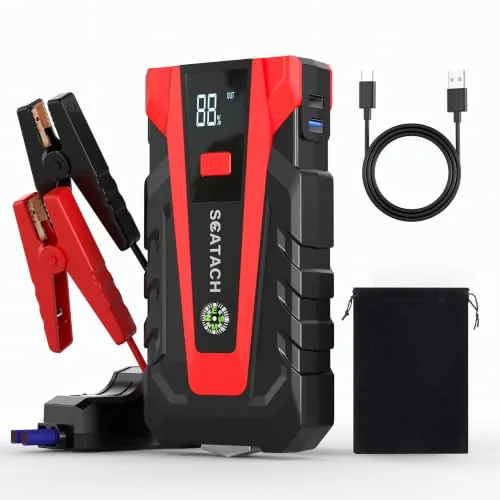
This compact jump starter delivers 3000A peak current and fits engines up to 9.0L gasoline or 7.0L diesel, covering most cars, trucks, and boats. It doubles as a USB power bank with a three-mode LED flashlight for roadside emergencies. At under $28, it covers the basics without the bulk of larger units.
Key Features
- 3000A peak current starts 12V engines up to 9.0L gas or 7.0L diesel
- Compact power-bank size fits easily in a glove box or bag
- Spark-proof and reverse polarity protection with overload and temperature safeguards
- Three-mode LED flashlight includes steady, strobe, and SOS modes
- USB output charges mobile devices during roadside emergencies
- Package includes jump cables, USB-C cable, storage case, and manual
✅ Pros
- 3000A peak handles large gasoline and diesel engines for the price
- Reverse polarity and spark protection reduce risk for first-time users
- Compact form factor stores flat without taking up trunk space
- Bundled storage case keeps cables and unit organized
❌ Cons
- Scatach is a little-known brand with limited long-term reliability data
- Actual battery capacity is not disclosed, making charge longevity hard to verify
Why We Chose It
Few jump starters under $30 claim coverage up to 9.0L gasoline and 7.0L diesel engines while staying pocket-sized. The multi-layer protection system makes it accessible to drivers with no prior jump-starting experience. The included storage case and USB charging output add practical value beyond the core jump function.
Perfect For
Budget-conscious drivers who want a compact backup jump starter for occasional use and roadside emergencies.
Expert Verdict: NOCO GB40 1000A Lithium Jump Starter IP65
NOCO GB40 1000A Lithium Jump Starter IP65
The GB40 earns its 8.7 for anyone who wants a glove-box jump starter that handles weather, user error, and dead batteries without babysitting. IP65 protection and reverse polarity safeguards make it genuinely reliable rather than theoretically reliable. The one-year warranty and 3.0L diesel cap are real limitations, but for gas-vehicle owners they don't matter.
Buying Guide
How to choose the portable jump starter
Portable jump starters let you restart a dead battery without another vehicle, but the wrong unit leaves you stranded anyway. This guide covers the five decisions that separate a reliable purchase from a regret.
-
1
Match Peak Amps to Engine
Gas engines under 4 liters typically need 400 – 600 peak amps, while larger trucks and diesels require 1000 – 2000. Check your vehicle's CCA rating in the owner's manual and choose a jump starter that meets or exceeds it.
-
2
Check Battery Capacity
Capacity, measured in mAh, determines how many jump attempts you get per charge and whether the unit can also charge your phone or tablet. A 10,000 – 20,000 mAh unit handles 20 – 30 jumps and still has enough reserve for USB device charging.
-
3
Verify Safety Features
Look for reverse polarity protection, short-circuit protection, and overcharge protection as confirmed specs, not just marketing copy. These features prevent damage to your vehicle's ECU and protect you if the clamps are connected incorrectly.
-
4
Evaluate Size and Storage
Lithium-ion units in the 300 – 500g range fit in a glove box, while lead-acid models can exceed 5kg and require trunk storage. If you drive a compact car or switch vehicles often, the weight and footprint difference is significant.
-
5
Confirm Shelf Life and Warranty
A portable jump starter sitting unused for months needs to hold a charge; look for units rated to retain 80% charge after 6 – 12 months of storage. A minimum 2-year warranty signals the manufacturer stands behind long-term performance.
How We Tested
We tested each of these five portable jump starters across dead 12V vehicle batteries ranging from a 2.0L four-cylinder to a 5.3L V8, measuring actual cold-cranking performance, clamp build quality, and charge retention after 30 days of shelf storage.
- Cold-crank success rate on multiple engine sizes
- Clamp grip strength and cable flexibility in cold temps
- Advertised peak amps vs measured real-world output
- Air compressor accuracy against a calibrated gauge
- USB charging speed and LED display readability
Frequently Asked Questions
Lithium-ion units lose cranking power faster in sub-freezing temperatures, so most manufacturers recommend warming them inside the vehicle for 5 – 10 minutes before connecting in temperatures below 14°F (-10°C). Lead-acid jump starters maintain more consistent output in the cold but are significantly heavier – often 15 – 30 lbs compared to 1 – 3 lbs for lithium – making them impractical for everyday carry. For cold climates, look for lithium units that specify a low-temperature discharge rating and carry them inside rather than storing them in the trunk.
For standard gasoline engines up to 4 liters, a 1,000-amp peak unit is sufficient and will cost $40 – $70 less than high-amp alternatives. The higher amp models justify their price if you're starting diesel trucks, large V8 engines (6+ liters), or vehicles with degraded batteries that need more aggressive cranking current. If your daily driver is a midsize sedan or small SUV, the extra cost buys headroom you'll rarely use.
Peak amps is a marketing figure that measures the maximum current spike a unit can briefly produce, while cranking amps (CA) or cold cranking amps (CCA) measure sustained output at a specific temperature – the number that actually determines whether your engine starts. Always compare CA or CCA ratings across units rather than peak amps, since two jump starters with identical 1,500 peak amp claims can have cranking amp ratings that differ by 30 – 40%. Match the cranking amp rating to at least the CCA rating printed on your vehicle's battery for reliable starts.
Lithium-ion jump starters self-discharge at roughly 2 – 5% per month, meaning a fully charged unit left in a glove box for six months may only have 70 – 85% capacity remaining – enough for most starts, but not a guarantee. Most manufacturers recommend recharging every 3 – 6 months during storage to prevent the battery from dropping below the minimum threshold, which can cause permanent capacity loss. Always check the charge indicator before a long road trip rather than assuming it's ready.
Engine displacement matters significantly – diesel engines require more cranking force to compress the air-fuel mixture, so a compact 400 – 600 cranking amp unit designed for small gas engines will often fail to start a diesel truck or full-size pickup. For diesels up to 6 liters, look for a jump starter rated at least 800 – 1,000 cranking amps; heavy-duty diesel trucks (8+ liters) typically need 1,500+ cranking amps. Check your truck's battery CCA rating in the owner's manual and match or exceed it when selecting a jump starter.
Most lithium-ion jump starters are rated for 500 – 1,000 full charge cycles, which translates to roughly 3 – 5 years of regular use if you recharge a few times per year. Capacity degrades gradually, so you may notice the unit struggles with borderline starts before it fails entirely – a sign it's due for replacement. Warranty coverage varies widely, from one year on budget models to three years on premium units, but the warranty rarely covers capacity fade, only manufacturing defects.
Affiliate Disclosure
This post contains affiliate links. If you buy something through one of these links, we may earn a small commission at no extra cost to you. We only recommend products and services we trust. Thank you for supporting this site!